England · delivered by councils · 1 April 2025 to 31 March 2028

Warm Homes Local Grant: is your council funding upgrades for homes like yours?

If your home is cold, costly to heat and your income is modest, your council may be able to pay for insulation, solar panels or a heat pump, with nothing to repay. This guide shows who qualifies, what the money covers and which council runs it where you live, using the government's own figures.

  • Up to £16,600 for insulation, solar and batteries, plus up to £16,600 for low carbon heating, per home on average
  • Owner occupiers and private tenants pay £0; landlords pay 50% from their second home
  • 73 lead authorities and 204 partner councils on the GOV.UK list, with £483.3m allocated
Council lookup

Is my council delivering it?

Type your district, borough, city or unitary council. Checked against the GOV.UK list of 73 lead authorities and 204 consortium members (updated 2 July 2026).

Your result appears here: the project your council sits in, its funding allocation and how many eligible postcodes it has.

Being on the list means your council received an allocation. It does not mean it has capacity today: councils can run waiting lists or pause sign-ups. See the full table or check your postcode.

Start here

Three gates every household has to get through

Quick answer: you need a low income (shown by postcode, benefit or income), a privately owned home in England rated EPC D to G, and a council with funding and capacity. Most people who miss out fail the second or third gate, not the first.

A low household income

You only need one of three routes:

  • your postcode is one of the 254,014 on the government's eligible list
  • someone in the home gets Universal Credit, Pension Credit, Housing Benefit, income-based JSA, income-related ESA or Income Support
  • gross household income is £36,000 or less, or under the after-housing-costs limit

The right kind of home

In England, already lived in, owned by you or a private landlord, and rated EPC D, E, F or G (an energy score of 68 or below). Homes rated A to C are excluded in every case. Park homes qualify if they are a permanent home with an equivalent rating.

A council that can deliver

Over 97% of eligible local authorities in England took part, but money and contractor capacity vary. Greater Manchester and the West Midlands run a separate devolved route. Use the lookup above or the full council table.

Living in a listed postcode is the quickest route because there is no income check, though you still need proof of address and the home still needs its EPC. The benefits route also skips the income check. The income route needs evidence: councils are not allowed to accept a self-declaration. If none of the three fits today, a change of circumstances, such as a new Pension Credit award, can change the answer. The full eligibility guide covers the edge cases: lodgers, students, disability benefits, and the ECO4 Flex route for homes rated E to G.

The EPC rule is the one people most often miss. A certificate grades the home from band A (most efficient) to G, and the scheme draws its line between C and D, at an energy efficiency score of 68. You can look up any existing certificate free on the GOV.UK register. EPCs for existing homes have been produced with the RdSAP 10 method since 15 June 2025, so if the home has changed since its last certificate, ask the council whether a fresh assessment is needed. How the EPC rule works.

EPC band ladder: bands A to C (SAP 69 and above) are not eligible; bands D to G (SAP 68 and below) are eligible for the Warm Homes: Local Grant
The EPC line that decides the property test. Source: DESNZ policy guidance s5.1.
What the money covers

Two pots per home, and nothing to pay back

Think of it the other way round from a loan. A household that pays for loft insulation, solar panels and a heat pump itself is spending thousands up front on a home that loses heat. Under this grant the council pays for the package that the survey recommends, the upgrade stays with the home, and the household keeps the lower bills. There is no interest, no instalment and nothing to repay.

The guidance sets two separate caps per home, averaged across each council's project: £16,600 for energy performance measures (insulation, glazing, doors, heating controls, solar PV, batteries) and £16,600 for low carbon heating (heat pumps, high heat retention storage heaters and, in rare rural cases, biomass). Both rose from £15,000 in the June 2026 update, so many sites still quote the old £30,000 total.

38%of measures fitted so far are solar PV
24%are insulation of one kind or another
18%are batteries, which must sit alongside solar

Solar and batteries do most work when you use the power yourself, so the retrofit coordinator is told to check whether a time-of-use tariff would suit you and whether a smart meter is fitted. Fossil fuel heating is never funded: no new gas, oil or LPG boilers. Every measure, pot by pot.
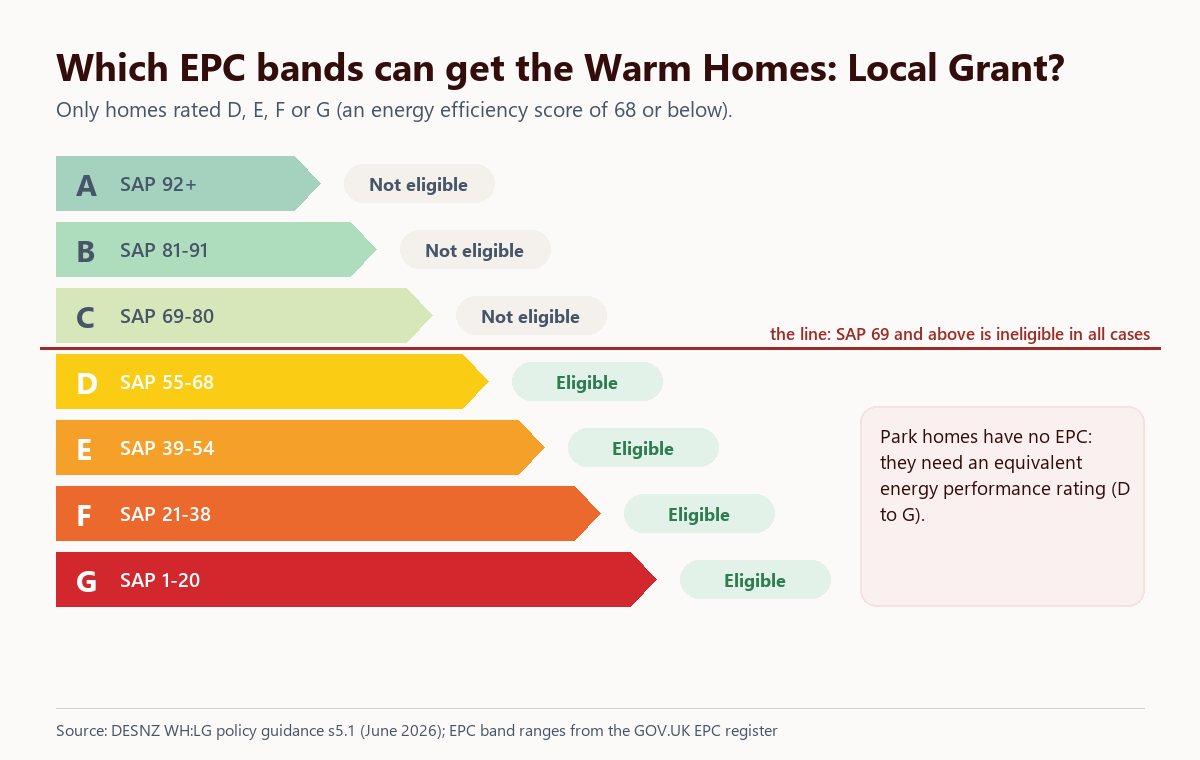
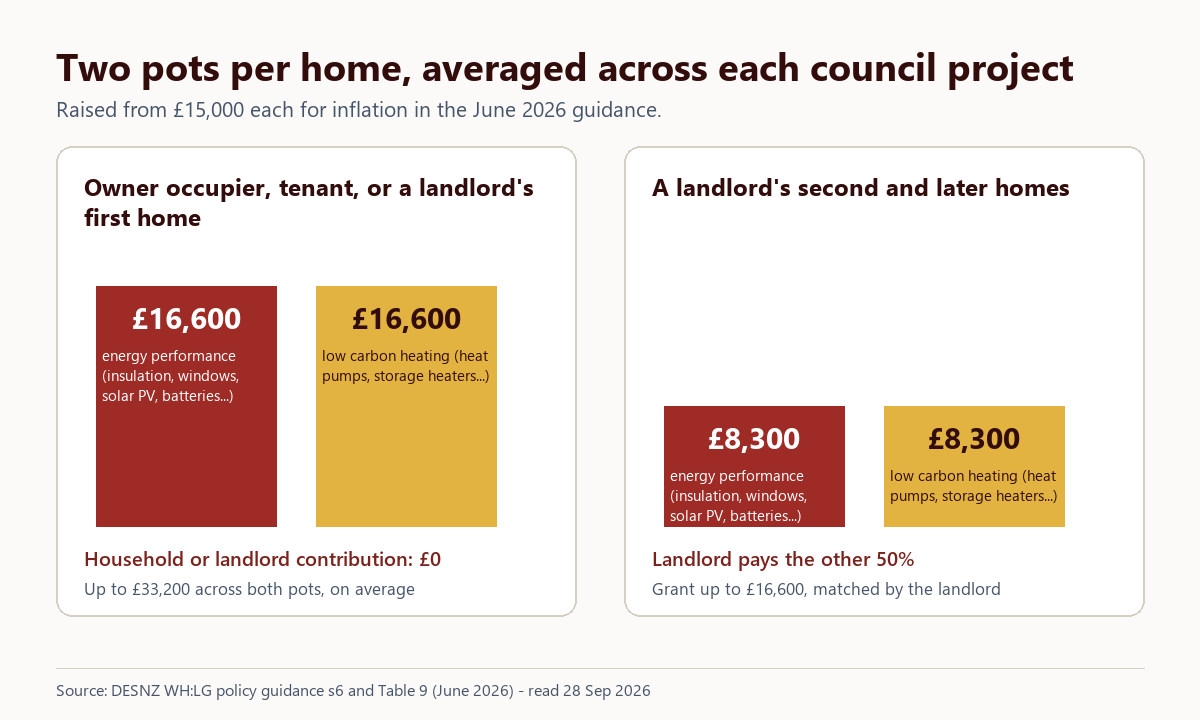
Diagram of the two Warm Homes: Local Grant cost caps: £16,600 energy performance and £16,600 low carbon heating per home, and £8,300 each for a landlord's second and later homes
The twin cost caps. Source: DESNZ policy guidance s6 and Table 9.
How it works

How your council delivers it, step by step

The Department for Energy Security and Net Zero funds it; your council (often as part of a consortium) runs it, procures the installers and signs off the work.

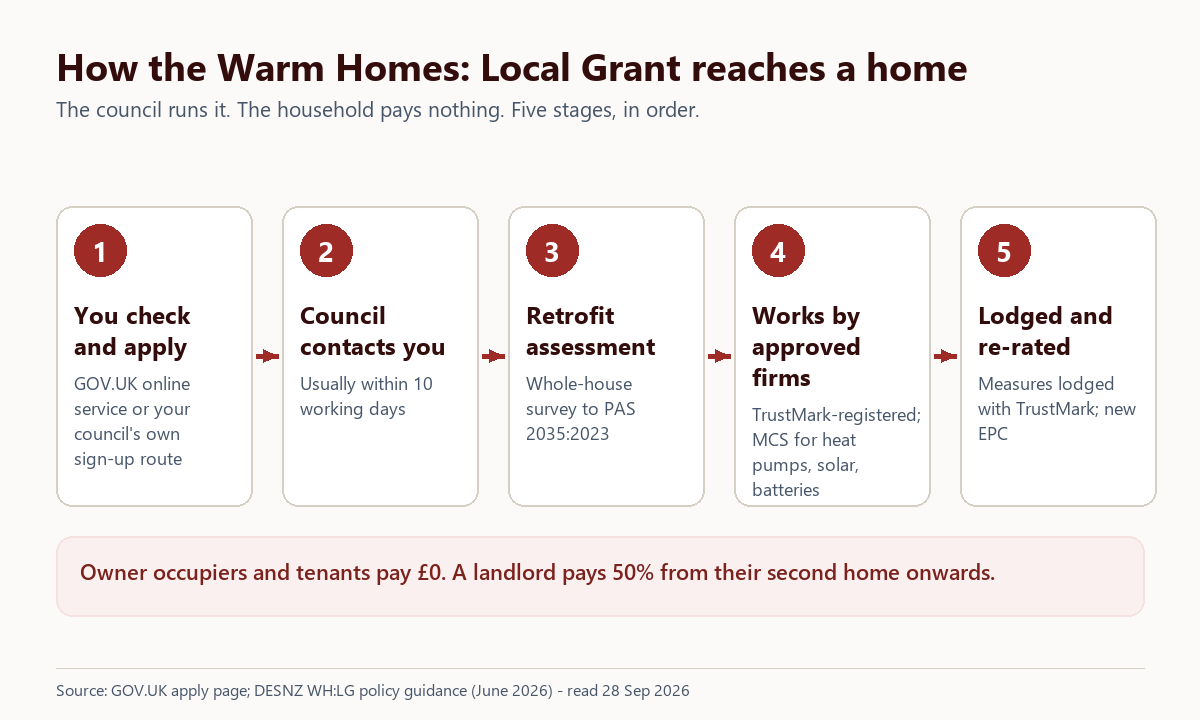
  1. Apply through the official route

    The GOV.UK online service asks about your home, income and heating, then passes an eligible application to your council. Many councils also run their own sign-up page.

  2. The council gets in touch

    Usually within 10 working days, by email or phone, to gather evidence and book a survey.

  3. A whole-house retrofit assessment

    Carried out to PAS 2035:2023. A retrofit coordinator agrees a package with you that aims for EPC C where the caps allow.

  4. Work by registered installers

    TrustMark-registered, and MCS-certified for heat pumps, solar and batteries, with a guarantee in place before work starts.

  5. Lodged and re-rated

    Every measure is lodged with TrustMark and the home gets a new EPC.

Five-stage flow: you check and apply, the council contacts you, a retrofit assessment is carried out, approved firms fit the measures, the work is lodged with TrustMark and the home gets a new EPC
From application to a re-rated home. Sources: GOV.UK apply page; DESNZ policy guidance.

What happens next is always your choice. You can stop at any step, turn down a heat pump, or accept only part of a package. Applying costs nothing, and no legitimate council partner will ask you for a fee or bank details to "release" a grant.

Before anyone starts work, you can check the firm yourself on the TrustMark and MCS registers in a few minutes. Here is how, and here is how to spot a fake offer.

Stuck on the form or the evidence? GOV.UK lists an assisted digital helpline for the online service (Monday to Friday 8am to 6pm, Saturday 9am to 12pm); the number is on the official apply page. Full application guide.

Illustrative example

One terraced house, two owners, two very different bills

An illustrative example, not a real household: it uses only the published caps to show how tenure changes who pays.

Illustrative example

Owner occupier on Pension Credit

A pre-1919 mid-terrace rated EPC E. The retrofit coordinator recommends internal wall insulation, a loft top-up, solar PV and a battery, all energy performance measures.

PathwayBenefit (Pension Credit)
Pot usedEnergy performance
Grant ceiling (project average)£16,600
Household pays£0
Illustrative example

Same house, a landlord's second rental

The tenant's income qualifies, the landlord already had one home funded, and the same package is recommended.

PathwayTenant's income
Pot usedEnergy performance
Grant ceiling (project average)£8,300
Landlord pays50% of the cost
Tenant pays£0

Add a heat pump to either package and the second pot opens: another £16,600 for the owner occupier, or £8,300 of grant for the landlord with a matching contribution. Try other combinations in the grant estimator; landlord rules are on the landlords page.

Which scheme is which

Local Grant, Warm Homes Plan, Warm Home Discount: not the same thing

Five government schemes share almost the same name. Only one of them pays your council to upgrade your home this way.

Scheme status as read on the official pages on 28 September 2026.
SchemeWhat it isWho it is forMoneyDates
Warm Homes: Local GrantCouncil-delivered insulation, solar, batteries and low carbon heatingLow-income owner occupiers and private tenants in England, EPC D to GUp to £16,600 + £16,600 per home on average; household pays £0Delivery 1 April 2025 to 31 March 2028
Warm Homes PlanThe umbrella programme: grants, loans and new rulesEveryone, with around £5 billion aimed at low-income households£15 billion of public investment to 2030Published 21 January 2026
Warm Homes: Social Housing FundUpgrades to social housingCouncils and housing associations, not individual householdsSeparate allocations to social landlordsPlanned to merge with the Local Grant from 2027/28
Warm Home DiscountA rebate on the electricity bill, not an upgradeQualifying households; usually automatic£150 off the billReopens October 2026
ECO4Energy-supplier obligationLow-income and vulnerable households in Great BritainVaries by measureEnds 31 December 2026
Boiler Upgrade SchemeGrant towards a heat pump or biomass boilerAny eligible owner in England and Wales, no income test£7,500, or £9,000 replacing oil or LPG off the gas gridRuns to 31 March 2028

The Warm Homes Plan, published on 21 January 2026, is the umbrella: £15 billion to upgrade up to 5 million homes by 2030, with around £5 billion aimed at low-income households. The Local Grant is how most of that low-income money reaches private homes today. The full comparison.

Council coverage

Where the money went, council by council

The GOV.UK list, updated on 2 July 2026, names 73 lead authorities and 204 councils working with them in consortia, with allocations totalling £483.3m. The biggest projects are run by the Midlands Net Zero Hub (with 47 councils), the Greater London Authority (with 31 boroughs) and a Lancashire consortium led by Blackpool.

254,014eligible postcodes on the DESNZ list
17councils on a devolved route in Greater Manchester and the West Midlands
11councils with eligible postcodes not named on the list

Councils in Greater Manchester and the West Midlands are missing from the national list because their combined authorities receive warm homes money through integrated settlements. 11 other councils, including Kirklees, Nottingham and Rotherham, have neighbourhoods on the eligible postcode list but do not appear by name, so residents there should ask the council directly. See every council.

Is there a catch? The honest answers

Grant schemes attract suspicion, and some of it is earned. Here is what the published rules actually say.

Is it really free?

For owner occupiers and private tenants, yes. The policy guidance says owner occupiers must not be required to contribute, and tenants are not expected to pay either. The council funds the agreed package up to the caps. You can choose to pay for extras the retrofit coordinator did not recommend, but nobody can make that a condition.

The one group that pays is landlords: a landlord's first home can be fully funded, and each further home needs a 50% contribution.

Will I have to repay it if I sell or move?

It is a grant, not a loan, and the published guidance contains no repayment mechanism for households. Landlords sign a declaration that they will not raise the rent because of the funded work, and the landlord's funding counts towards a public subsidy limit. If anyone describes the Warm Homes: Local Grant as a loan to be repaid, ask them for it in writing and check with your council.

Can the council say no even if I meet the rules?

Yes. Councils must verify eligibility with evidence and can decline a household with substantial savings or assets, because the scheme is aimed at homes in or at risk of fuel poverty. They also decide how to manage demand when there are more eligible households than money, as long as the approach is fair and consistent. Meeting the rules gets you into the process; it does not guarantee a package.

Do I have to accept a heat pump?

No. The guidance says the final decision to install a heat pump, storage heaters or any other heating system rests solely with the household, and that you must be given clear advice on the likely effect on your bills first. You can accept insulation or solar and decline the heating change.

What if my council is not taking applications?

Allocation is not the same as capacity. Some councils run waiting lists or pause sign-ups while contractors catch up. Register anyway through the official route, ask the council how it prioritises, and look at the other routes for anything urgent.

The dates that actually matter

No countdown clocks here: just the fixed dates in the published guidance, and what each one means for a household.

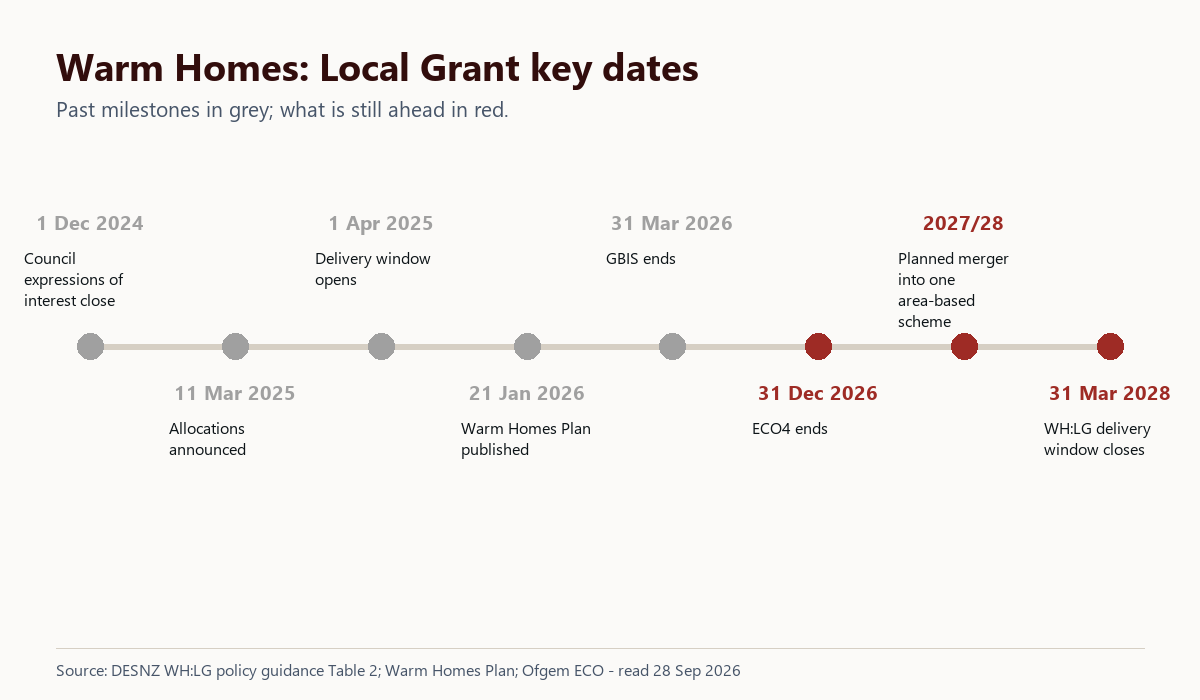
  • 31 December 2026ECO4, the energy-supplier scheme, closes (after a nine-month extension). There is no supplier-funded successor: the Warm Homes Plan moved low-income support to government grants such as this one.
  • 2027/28The government intends to merge the Warm Homes: Local Grant and the Social Housing Fund into a single low-income scheme with more area-based delivery. Names and routes may change.
  • 31 March 2028The Warm Homes: Local Grant delivery window closes. Councils manage demand in their own way, so an early place in the queue can matter more than the end date.
  • 31 March 2027If you pay for any upgrade yourself, 0% VAT on installing energy-saving materials in homes ends and 5% applies (VAT Notice 708/6). Grant-funded work costs you nothing either way.
Timeline of Warm Homes: Local Grant dates from council expressions of interest closing on 1 December 2024 to the delivery window closing on 31 March 2028
Key dates. Sources: DESNZ policy guidance Table 2; Warm Homes Plan; Ofgem.

Warm Homes Local Grant: common questions

Who qualifies for the Warm Homes: Local Grant?

Households in England on a low income living in a privately owned home rated EPC D to G. Low income is shown in one of three ways: living in an eligible postcode (IMD income deciles 1-2), someone in the home getting a listed means-tested benefit such as Universal Credit or Pension Credit, or a gross household income of £36,000 or less (or under the after-housing-costs limit for your household). Owner occupiers and private tenants can apply; social housing is excluded except as infill.

Is the warm homes grant still available?

Yes. The Warm Homes: Local Grant delivery window runs from 1 April 2025 to 31 March 2028, and 74 council projects covering 271 local authorities were given funding. Availability on the ground varies by council: some have waiting lists. The separate Warm Home Discount (£150 off the electricity bill) reopens in October 2026.

How much can I get?

Up to £16,600 for energy performance upgrades and up to £16,600 for low carbon heating per home, as an average across the council's project. The caps were raised from £15,000 each in the June 2026 guidance, so older articles quoting £30,000 are out of date. Owner occupiers and tenants pay nothing.

Can I get free windows and doors?

Possibly, but only as part of a package the retrofit assessment recommends. Double and triple glazing and energy efficient doors are eligible energy performance measures, but glazing has a price limit councils must meet on average, so it is often not the first measure chosen. Insulation, solar PV and batteries are fitted far more often.

Can I get a new boiler under the Warm Homes: Local Grant?

No. Fossil fuel heating is not funded, so a new gas, oil or LPG boiler cannot be paid for. In a home currently heated by mains gas, a retrofit or packaged hybrid system is allowed, but only the heat pump part is funded.

What home grants am I eligible for if not this one?

It depends on your home and income. The Boiler Upgrade Scheme gives £7,500 towards a heat pump with no income test (£9,000 if replacing oil or LPG off the gas grid, until 31 March 2027), installation of energy-saving materials is VAT-free until 31 March 2027, and Scotland, Wales and Northern Ireland run their own schemes.

Do I apply to the council or to the government?

Either route ends with your council. GOV.UK runs an online eligibility checker that passes eligible applications to the right council, which usually contacts you within 10 working days; many councils and consortia also run their own sign-up pages.

Is this website the council or the government?

No. This is an independent guide published by SEO-DONS LTD. It cannot approve or speed up an application and there is nothing to pay to apply. Use GOV.UK or your council to apply.

Want a second opinion, or help with what the grant will not cover?

Apply for the grant itself through the official GOV.UK service or your council: it is free and you do not need a go-between. Use this form if you would also like independent retrofit or installation firms that cover your postcode to contact you, for a second opinion, a quote for work outside the grant, or options if you do not qualify. We pass your enquiry on. We cannot approve, speed up or guarantee a grant.

What happens next

  1. We read your enquiry and check which kind of firm can help.
  2. We pass it to relevant independent firms that cover your postcode.
  3. They contact you with questions or a quote. You compare, and decide — with no obligation to go ahead.
Add a little more detail (optional — helps the right firm reply)

We share your details only with the firms we pass your enquiry to, and only for this enquiry. This site is an independent guide — not an installer, assessor or scheme administrator. See our privacy notice.

Check eligibility Ask about my home
Ask about my home