How to check an installer: TrustMark, MCS and PAS 2030
Why checking matters on a grant
Grant-funded work is paid for by the council, but it is your home. The scheme’s standards exist so that measures are fitted properly and there is a record and a guarantee if something goes wrong. A quick check also protects you from firms that use the scheme’s name without being part of it. Spotting fake offers.
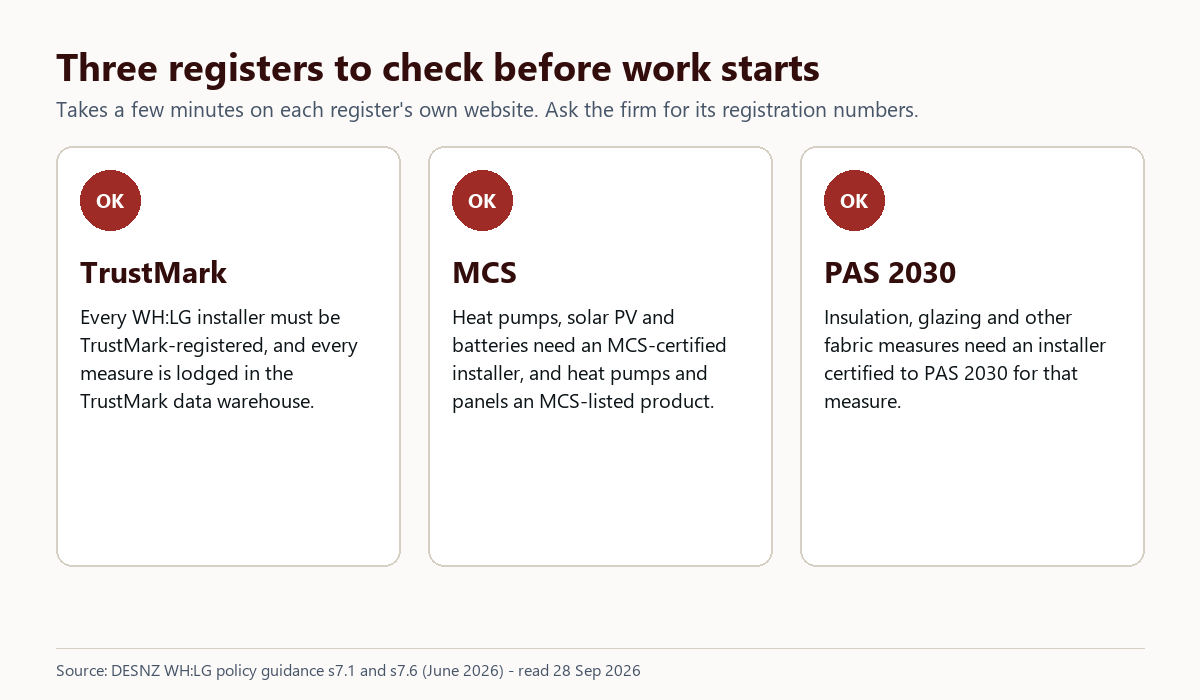
The three registers
| Register or standard | Who needs it under the Warm Homes: Local Grant | How to check |
|---|---|---|
| TrustMark | Every installer, for every measure | Search the business on the TrustMark website |
| MCS | Heat pumps and other low carbon heating, solar PV, batteries (plus MCS-listed products for heat pumps and solar) | Search the MCS “find an installer” directory |
| PAS 2030 | Insulation and other energy efficiency measures | Ask for the firm’s PAS 2030 certificate for the specific measure; TrustMark registration covers the measures a business is registered for |
The policy guidance puts it simply: installers “must be Trustmark registered and certified under the latest version of PAS 2030 or by MCS to install the relevant eligible measures”, and “all measures must be lodged onto the Trustmark data warehouse”.
Step by step
- Ask for details in writing. The firm’s full legal name, its TrustMark registration and, where relevant, its MCS certificate number. A legitimate council contractor will give them without fuss.
- Look it up yourself. Go to the TrustMark and MCS websites directly rather than following a link someone sends you.
- Match the measure. Check the registration covers the specific work (for example, external wall insulation or air source heat pumps), not just “home improvements”.
- Match the council. If the firm says it is working for your council, confirm with the council or its named delivery partner.
- Get the guarantee. A measure guarantee must be in place before work starts. Ask for the paperwork and keep it.
What changed in June 2026
The original guidance allowed installers certified to schemes “deemed equivalent to MCS”. The June 2026 update removed that provision: installers must now be MCS-certified in all cases for the relevant measures. It also updated TrustMark lodgement guidance and confirmed Building Regulations requirements.
MCS in 2026: two versions
MCS (the Microgeneration Certification Scheme) covers small-scale renewable technologies of 50 kW or less, such as heat pumps and solar panels, with product standards, installation standards and installer certification. Installers must belong to a UKAS-accredited certification body.
At present two versions operate: the original scheme and a redeveloped one (called MCS2025). Installers still on the original scheme must also belong to a consumer code of practice approved by the Chartered Trading Standards Institute, which offers alternative dispute resolution. Installers on the redeveloped scheme do not have to join a consumer code, although they can. Ask which applies to your installer so you know where a complaint would go.
Batteries
Batteries under the grant must be installed by an MCS-certified installer to the MCS battery installation standard (MIS 3012), and comply with PAS 63100 and PAS 2035. During the current interim period, a battery does not need to be on the MCS product directory.
If you are paying yourself
The same checks apply if you commission work outside the grant. They also matter for money: 0% VAT on installing energy-saving materials in homes (until 31 March 2027) applies when the installer both supplies and fits the materials, and the Boiler Upgrade Scheme is claimed through your installer rather than by you.
Quick check: do the rules fit your home?
Four questions, about a minute. No details needed and nothing is sent anywhere.
This explains the published rules. Only your council (or its delivery partner) can confirm eligibility, after checking evidence.
Installer questions
The council chose the installer. Do I still need to check?
It is still worth two minutes. The council is responsible for making sure its contractors meet the standards, but checking the name on the van or paperwork against the register confirms you are dealing with the firm the council appointed, not someone using its name.
The firm says it is 'MCS-equivalent'
That is no longer accepted. The June 2026 guidance removed the earlier provision for schemes deemed equivalent to MCS: installers must be MCS-certified in all cases for the relevant measures.
Where do I complain if something goes wrong?
Start with the council or its delivery partner, which runs the project. Keep your guarantee paperwork: a measure guarantee must be in place before work starts. For MCS installers still on the original MCS scheme, membership of an approved consumer code with alternative dispute resolution is required; installers on the redeveloped MCS scheme do not have to join one, though many may.
Questions people ask
Does a Warm Homes: Local Grant installer have to be TrustMark registered?
Yes. All installers must be TrustMark-registered and meet TrustMark's requirements for the scheme, and every measure must be lodged in the TrustMark data warehouse.
When is MCS needed?
For low carbon heating such as heat pumps, for solar PV, and for batteries. Heat pumps and solar panels must also be MCS-listed products. High heat retention storage heaters are the exception, covered by PAS 2030.
What is PAS 2030?
The installation standard for energy efficiency measures such as insulation. Installers of those measures must be certified to the latest version of PAS 2030 for the measures they install.
What is PAS 2035?
The whole-house retrofit standard (currently PAS 2035:2023) that every Warm Homes: Local Grant project follows, from the retrofit assessment through design, installation and evaluation.
Is there an approved installer list for the Warm Homes: Local Grant?
Not a public one. Each council or consortium procures its own installers. Check any firm on the TrustMark register and, for heat pumps, solar and batteries, the MCS installer search.
Can I use my own installer?
Generally not for grant-funded work: the council procures the supply chain. If you are paying for something outside the grant, you choose, and the same checks apply.
Sources
- DESNZ, Warm Homes: Local Grant Policy Guidance for Local Authorities (updated June 2026; GOV.UK update 2 July 2026) (read 28 September 2026)
- TrustMark, find a registered business (read 28 September 2026)
- MCS, find an installer (read 28 September 2026)
Want a second opinion, or help with what the grant will not cover?
Apply for the grant itself through the official GOV.UK service or your council: it is free and you do not need a go-between. Use this form if you would also like independent retrofit or installation firms that cover your postcode to contact you, for a second opinion, a quote for work outside the grant, or options if you do not qualify. We pass your enquiry on. We cannot approve, speed up or guarantee a grant.
What happens next
- We read your enquiry and check which kind of firm can help.
- We pass it to relevant independent firms that cover your postcode.
- They contact you with questions or a quote. You compare, and decide — with no obligation to go ahead.