Warm Homes Local Grant timescales: how long it takes and when it ends
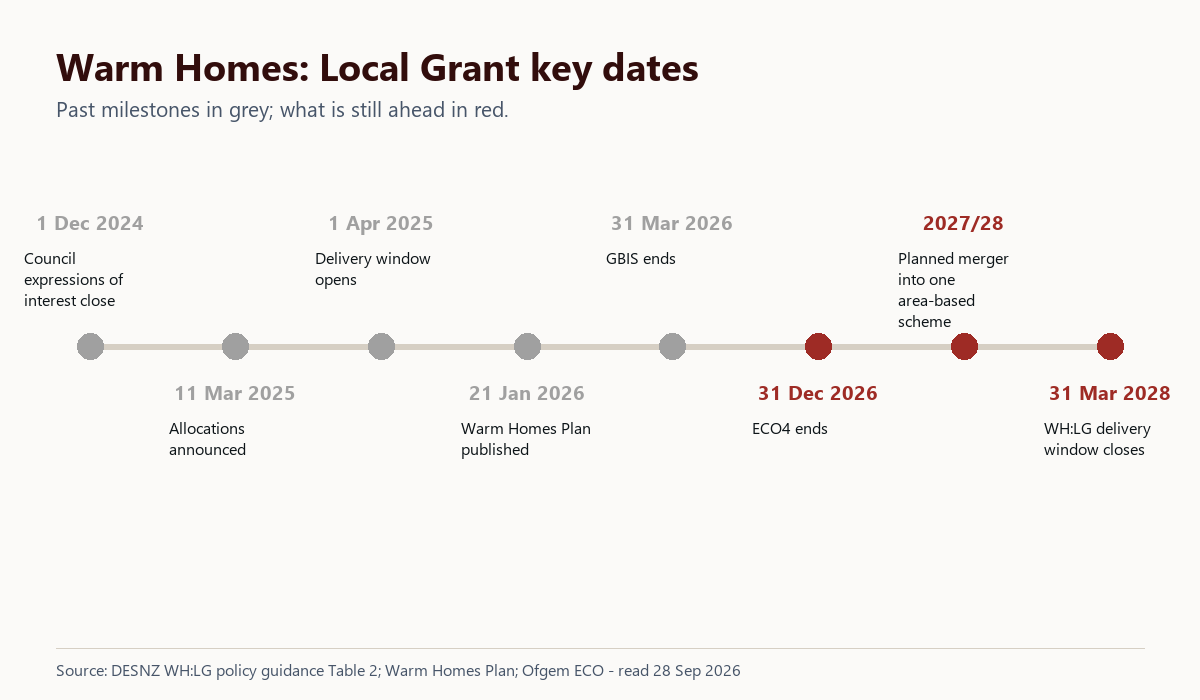
The scheme’s key dates
| Date | What happened or happens |
|---|---|
| 16 October 2024 | Council expression of interest window opens |
| 1 December 2024 | Expression of interest window closes |
| 11 March 2025 | Funding allocations announced |
| 1 April 2025 | Delivery window opens; delivery assurance checks begin |
| 21 January 2026 | Warm Homes Plan published |
| 31 March 2026 | Great British Insulation Scheme ends |
| June 2026 | Policy guidance updated: caps rise to £16,600 each |
| 31 December 2026 | ECO4 ends |
| 2027/28 | Planned merger into a single area-based low-income scheme |
| 31 March 2028 | Warm Homes: Local Grant delivery window closes |
The guidance notes that dates “are subject to change, at the discretion of DESNZ”.
How long your application takes
There is no published average time from application to installation, and it varies widely between councils. What the rules do fix:
- First contact: GOV.UK says the council will usually contact you within 10 working days. For referrals from the national online checker, the delivery guidance makes this a requirement.
- Landlords: a fully funded offer cannot be confirmed until DESNZ or its delivery partner has checked the central landlord database, which it does weekly.
- After the work: the TrustMark project must be closed within six weeks of the work being completed.
Between those points sit the stages that take longest in practice: gathering evidence, the retrofit assessment, the package design, the council submitting your home in a batch for funding, and contractor scheduling.
Why queues form
Councils were allocated funding for the whole 2025 to 2028 window and draw it down in batches of homes that are “ready to retrofit”. The guidance lets each council decide how to handle more eligible households than it can serve, as long as its approach is fair and consistent: some use first come, first served; others prioritise. That is why two neighbouring councils can have very different waits.
What 2027/28 could change
The Warm Homes Plan says that “from 2027/28 onwards” the government intends to integrate the Warm Homes: Social Housing Fund and the Warm Homes: Local Grant into a single low-income capital scheme, shifting towards area-based delivery. The Plan also sets out a new Warm Homes Agency to coordinate delivery. The details were still to come when we checked on 28 September 2026. In practice, that could mean a new name, new rules or more street-by-street delivery. It does not change anything for work already agreed under the current scheme.
ECO4’s closure and what it means for timing
ECO4, the energy-supplier scheme, runs until 31 December 2026 after a nine-month extension. If a home is getting measures under both ECO4 and the Warm Homes: Local Grant, the ECO4 work must happen wholly before or wholly after, with a separate post-installation EPC and TrustMark lodgement for each. ECO4’s end explained.
Delivery so far
The August 2026 statistics, covering the scheme to the end of July 2026, show about 11,250 measures in about 5,470 households reported by 67 of the 74 grant recipients, and about 14,700 measures in about 6,700 households lodged with TrustMark. DESNZ warns that recent months are under-reported. Statistics moved to quarterly publication, with the next release on 26 November 2026. Read the statistics.
Quick check: do the rules fit your home?
Four questions, about a minute. No details needed and nothing is sent anywhere.
This explains the published rules. Only your council (or its delivery partner) can confirm eligibility, after checking evidence.
Timing questions, answered straight
Should I wait until nearer 2028?
There is no advantage in waiting. Councils decide how to manage demand, and some run waiting lists or pause sign-ups while contractors work through a queue. The end date is when delivery stops, not when you should apply.
Is there a deadline to apply?
No single national application deadline is published: the fixed date is the end of the delivery window, 31 March 2028, and councils must complete work before then. Your council may close its own sign-ups earlier if its allocation is committed, so ask.
Why is my council so slow?
Several stages sit between application and installation: evidence checks, the retrofit assessment, design, the council's batch approval and funding draw-down, contractor scheduling, and for landlords a central database check. Each can add time. Ask where you are in the queue and what the next step is.
The dates that actually matter
No countdown clocks here: just the fixed dates in the published guidance, and what each one means for a household.
- 31 December 2026ECO4, the energy-supplier scheme, closes (after a nine-month extension). There is no supplier-funded successor: the Warm Homes Plan moved low-income support to government grants such as this one.
- 2027/28The government intends to merge the Warm Homes: Local Grant and the Social Housing Fund into a single low-income scheme with more area-based delivery. Names and routes may change.
- 31 March 2028The Warm Homes: Local Grant delivery window closes. Councils manage demand in their own way, so an early place in the queue can matter more than the end date.
- 31 March 2027If you pay for any upgrade yourself, 0% VAT on installing energy-saving materials in homes ends and 5% applies (VAT Notice 708/6). Grant-funded work costs you nothing either way.
Questions people ask
When does the Warm Homes: Local Grant end?
The delivery window closes on 31 March 2028. From 2027/28 the government intends to integrate the Warm Homes: Local Grant and the Warm Homes: Social Housing Fund into a single low-income scheme with more area-based delivery.
How long after applying will I hear back?
GOV.UK says your council will usually contact you within 10 working days. For referrals from the GOV.UK online checker, councils are required to contact eligible households by email or phone within 10 working days.
How long does the whole process take?
It varies by council, contractor capacity and the size of the package. DESNZ does not publish an average. Expect separate steps for the evidence check, survey, design, approval and installation, and ask your council for its current timescales.
Is the Warm Homes: Local Grant running in 2027?
Yes. The delivery window runs until 31 March 2028. The scheme may be restructured from 2027/28 as part of the move to a single low-income scheme.
Is the Warm Homes: Local Grant running in 2026?
Yes. It opened for delivery on 1 April 2025. To the end of July 2026, councils had reported about 11,250 measures in about 5,470 households.
When are the next delivery statistics?
DESNZ moved the statistics from monthly to quarterly publication. The next release is due on 26 November 2026.
Sources
- DESNZ, Warm Homes: Local Grant Policy Guidance for Local Authorities (updated June 2026; GOV.UK update 2 July 2026) (read 28 September 2026)
- GOV.UK, Apply for the Warm Homes: Local Grant to improve a home (read 28 September 2026)
- DESNZ, Warm Homes: Local Grant Updated Delivery Guidance for Grant Recipients (GOV.UK update 2 July 2026) (read 28 September 2026)
- DESNZ, Warm Homes Plan (policy paper, published 21 January 2026, updated 18 March 2026) (read 28 September 2026)
- Ofgem, Energy Company Obligation (ECO) (read 28 September 2026)
- DESNZ, Warm Homes: Local Grant statistics - August 2026 (published 27 August 2026) (read 28 September 2026)
Want a second opinion, or help with what the grant will not cover?
Apply for the grant itself through the official GOV.UK service or your council: it is free and you do not need a go-between. Use this form if you would also like independent retrofit or installation firms that cover your postcode to contact you, for a second opinion, a quote for work outside the grant, or options if you do not qualify. We pass your enquiry on. We cannot approve, speed up or guarantee a grant.
What happens next
- We read your enquiry and check which kind of firm can help.
- We pass it to relevant independent firms that cover your postcode.
- They contact you with questions or a quote. You compare, and decide — with no obligation to go ahead.