Warm homes grant: which warm homes scheme is which in 2026
Why the names are so confusing
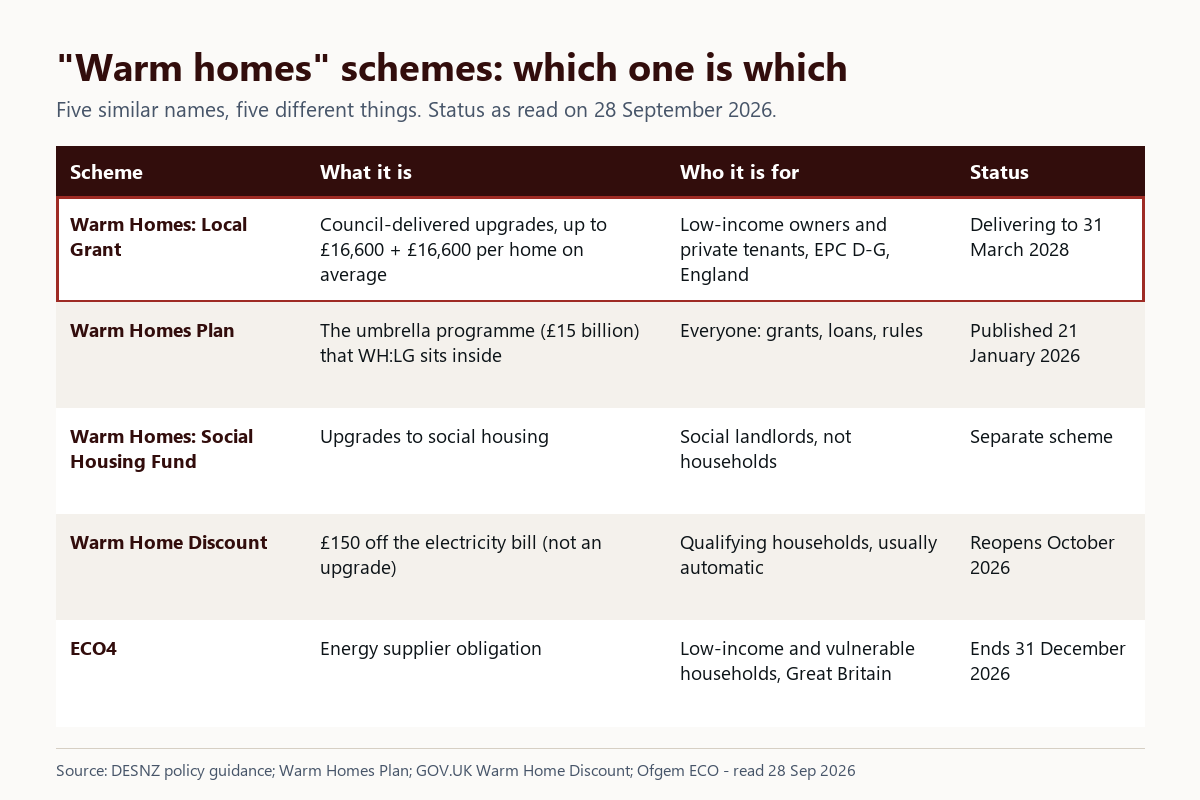
Government energy schemes have been renamed and restructured several times, and the current set shares one word: warm. Search results mix them freely. Here is what each one actually is, as set out on the official pages on 28 September 2026.
The Warm Homes: Local Grant
What it is: a £500 million government grant delivered by councils between 1 April 2025 and 31 March 2028. It pays for energy performance upgrades (insulation, glazing, doors, controls, solar PV, batteries) and low carbon heating (mainly heat pumps) in low-income households’ homes.
Who it is for: households in England on a low income (an eligible postcode, a listed means-tested benefit, or gross income of £36,000 or less) in privately owned or privately rented homes rated EPC D to G.
What you get: up to £16,600 for energy performance and up to £16,600 for low carbon heating per home, averaged across the council’s project. Owner occupiers and tenants pay nothing.
How to apply: through the GOV.UK online service or your council. Full guide.
This is the scheme this website covers. The guidance describes it as the single successor to the council-run Local Authority Delivery and Home Upgrade Grant schemes, open to homes on and off the gas grid.
The Warm Homes Plan
What it is: the government’s overall programme, published on 21 January 2026 and updated on 18 March 2026: £15 billion of public investment to upgrade up to 5 million homes by 2030.
What is in it: £4,422 million for low-income home grants over 2025/26 to 2029/30, £2,687 million for the Boiler Upgrade Scheme, £1,063 million for heat networks, and £5,300 million for a Warm Homes Fund that includes £2,000 million for consumer loans and £600 million for low-income households. Low-income and fuel-poor households benefit from around £5 billion in total.
Why it matters for the Local Grant: the Plan says low-income funding will be delivered “initially through the existing Warm Homes Social Housing Fund and Local Grant, before consolidating and integrating our investment into a single scheme for low-income households”. From 2027/28 it intends to merge the two into one low-income capital scheme with more area-based delivery.
You do not apply to “the Plan”. You apply to the scheme inside it that fits you.
The Warm Homes: Social Housing Fund
What it is: funding for social landlords (councils and housing associations) to upgrade social housing. Individual households do not apply.
Link to the Local Grant: social housing is excluded from the Local Grant except as infill; councils that want to upgrade their own stock are pointed to the Social Housing Fund. The two are due to merge from 2027/28.
The Warm Home Discount
What it is: a £150 discount off your electricity bill in winter. Your supplier applies it; the money is not paid to you. Most eligible people get it automatically.
Status: the 2025 to 2026 round has closed and the scheme reopens in October 2026. It does not pay for any upgrade to your home.
ECO4 and the Great British Insulation Scheme
What they were: obligations on energy suppliers to fund home upgrades. The Warm Homes Plan brought them to a close because they “did not represent strong value for money”. The Great British Insulation Scheme ended on 31 March 2026; ECO4 runs until 31 December 2026 to allow an orderly closure. What ECO4’s end means.
The Boiler Upgrade Scheme
Not a “warm homes” name, but often confused with them. It gives £7,500 towards an air-to-water or ground source heat pump in England and Wales, or £9,000 where an off-gas home replaces oil or LPG (until 31 March 2027), with no income test. It cannot pay for the same heat pump as the Local Grant.
Which one should you look at first?
- Low income, private home in England, rated D to G: start with the Warm Homes: Local Grant eligibility check.
- Not low income, but want a heat pump: the Boiler Upgrade Scheme.
- Struggling with this winter’s bill: check the Warm Home Discount when it reopens in October 2026.
- Social tenant: ask your landlord about the Social Housing Fund.
- Scotland, Wales or Northern Ireland: Warmer Homes Scotland, Nest, or the Affordable Warmth Scheme and NISEP.
Quick check: do the rules fit your home?
Four questions, about a minute. No details needed and nothing is sent anywhere.
This explains the published rules. Only your council (or its delivery partner) can confirm eligibility, after checking evidence.
The schemes side by side
| Scheme | What it is | Who it is for | Money | Dates |
|---|---|---|---|---|
| Warm Homes: Local Grant | Council-delivered insulation, solar, batteries and low carbon heating | Low-income owner occupiers and private tenants in England, EPC D to G | Up to £16,600 + £16,600 per home on average; household pays £0 | Delivery 1 April 2025 to 31 March 2028 |
| Warm Homes Plan | The umbrella programme: grants, loans and new rules | Everyone, with around £5 billion aimed at low-income households | £15 billion of public investment to 2030 | Published 21 January 2026 |
| Warm Homes: Social Housing Fund | Upgrades to social housing | Councils and housing associations, not individual households | Separate allocations to social landlords | Planned to merge with the Local Grant from 2027/28 |
| Warm Home Discount | A rebate on the electricity bill, not an upgrade | Qualifying households; usually automatic | £150 off the bill | Reopens October 2026 |
| ECO4 | Energy-supplier obligation | Low-income and vulnerable households in Great Britain | Varies by measure | Ends 31 December 2026 |
| Boiler Upgrade Scheme | Grant towards a heat pump or biomass boiler | Any eligible owner in England and Wales, no income test | £7,500, or £9,000 replacing oil or LPG off the gas grid | Runs to 31 March 2028 |
Mix-ups that cost people money
I applied for the Warm Home Discount, so I have applied for the grant
No. The Warm Home Discount is a £150 discount on your electricity bill, usually applied automatically by your supplier to eligible households. It does not upgrade your home. The Warm Homes: Local Grant is a separate application through GOV.UK or your council.
The Warm Homes Plan will pay for my heat pump
The Plan is a spending programme, not a single grant you apply to. It pays for several schemes, including the Local Grant for low-income households and the Boiler Upgrade Scheme for anyone installing a heat pump. Which one you use depends on your income and home.
Someone offered me a warm homes grant on the phone
Be careful. None of these schemes needs a cold call to access, and none charges a fee to apply. The Local Grant comes through GOV.UK or your council. How to spot a fake offer.
If the grant will not cover it
Some households will not qualify, some councils will have waiting lists, and some upgrades fall outside the package. These are the other ways the cost is met, with their conditions:
- Boiler Upgrade Scheme: £7,500 towards an air-to-water or ground source heat pump in England and Wales, or £9,000 where an off-gas home is replacing oil or LPG (until 31 March 2027); £2,500 for air-to-air. It cannot pay for the same heat pump as the Warm Homes: Local Grant.
- 0% VAT until 31 March 2027: installing insulation, heat pumps, solar panels and batteries in a home is zero-rated until then, and 5% after (VAT Notice 708/6).
- Loans under the Warm Homes Plan: the plan allocates £2,000 million for consumer loans through the Warm Homes Fund. Check GOV.UK for when and how they open; this site does not arrange credit.
- Mix and match, carefully: different schemes can fund different measures in the same home, but never the same measure twice.
Questions people ask
Is the warm homes grant still available?
The Warm Homes: Local Grant is delivering until 31 March 2028. From 2027/28 the government intends to merge it with the Warm Homes: Social Housing Fund into one low-income scheme, so the name and route may change before then. The Warm Home Discount reopens in October 2026.
What is the difference between the Warm Homes Plan and the Warm Homes: Local Grant?
The Warm Homes Plan, published on 21 January 2026, is the government's overall £15 billion programme to upgrade up to 5 million homes by 2030. The Warm Homes: Local Grant is one scheme inside it: £500 million delivered by councils from April 2025 to March 2028 for low-income households.
Who can get a warm homes grant?
For the Local Grant: low-income households in England (an eligible postcode, a listed benefit, or income of £36,000 or less) living in a privately owned or privately rented home rated EPC D to G.
Is the Warm Home Discount the same as the warm homes grant?
No. The Warm Home Discount is £150 off your electricity bill, paid through your supplier. It does not pay for insulation, solar or heating.
What replaced ECO4?
There is no supplier-funded successor. ECO4 ends on 31 December 2026 and the Great British Insulation Scheme ended on 31 March 2026. The Warm Homes Plan moved low-income support to government grants, starting with the Warm Homes: Local Grant.
Is there a warm homes grant in Scotland or Wales?
Not this one: the Warm Homes: Local Grant is England only. Scotland has Warmer Homes Scotland through Home Energy Scotland; Wales has Nest; Northern Ireland has the Affordable Warmth Scheme and NISEP.
Sources
- DESNZ, Warm Homes Plan (policy paper, published 21 January 2026, updated 18 March 2026) (read 28 September 2026)
- DESNZ, Warm Homes: Local Grant Policy Guidance for Local Authorities (updated June 2026; GOV.UK update 2 July 2026) (read 28 September 2026)
- GOV.UK, Warm Home Discount Scheme (read 28 September 2026)
- Ofgem, Energy Company Obligation (ECO) (read 28 September 2026)
- Welsh Government, Get help with energy efficiency in your home (Nest) (read 28 September 2026)
- Home Energy Scotland (read 28 September 2026)
- nidirect, Energy saving grants in your area (read 28 September 2026)
- GOV.UK, Notice of approved grant categories and values for the Boiler Upgrade Scheme (via reference/sales/urgency-data.json, last verified 2026-09-01) (read 28 September 2026)
Want a second opinion, or help with what the grant will not cover?
Apply for the grant itself through the official GOV.UK service or your council: it is free and you do not need a go-between. Use this form if you would also like independent retrofit or installation firms that cover your postcode to contact you, for a second opinion, a quote for work outside the grant, or options if you do not qualify. We pass your enquiry on. We cannot approve, speed up or guarantee a grant.
What happens next
- We read your enquiry and check which kind of firm can help.
- We pass it to relevant independent firms that cover your postcode.
- They contact you with questions or a quote. You compare, and decide — with no obligation to go ahead.