Energy grants for landlords under the Warm Homes Local Grant
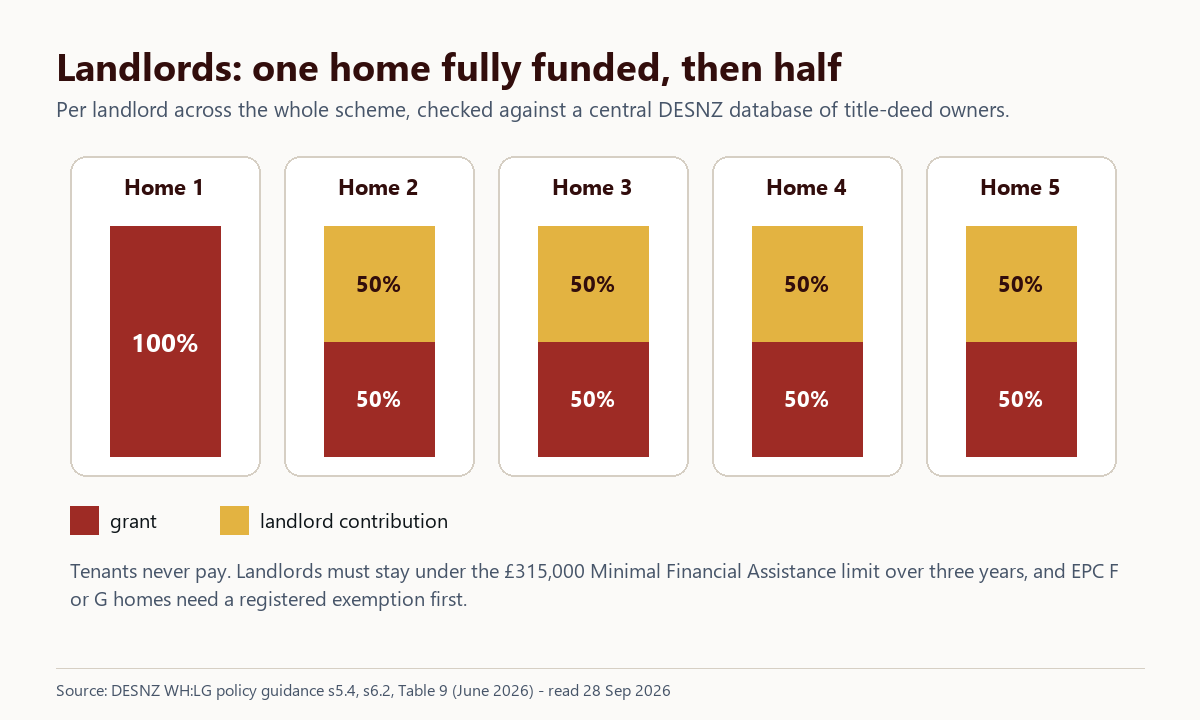
How the landlord offer works
The Warm Homes: Local Grant was designed to reach fuel-poor tenants in privately rented homes, a group the earlier Local Authority Delivery and Home Upgrade Grant schemes struggled to reach. The guidance calls its offer “more generous” for that reason.
| Your homes under the scheme | Grant (project average ceilings) | Your contribution |
|---|---|---|
| First home | up to £16,600 energy performance + up to £16,600 low carbon heating | £0 |
| Second home and each one after | up to £8,300 + up to £8,300 | 50% of the cost of works |
“First” means first across the whole scheme, not first per council. The count follows the owners named in the title deeds, so it applies to you however many projects or council areas your homes sit in.
What makes a rented home eligible
The tenant’s household must be on a low income through one of the three pathways: an eligible postcode, a listed means-tested benefit, or a gross household income of £36,000 or less (or under the after-housing-costs limit).
The home must be in England, already lived in, and rated EPC D, E, F or G. For F and G homes there is an extra step: the landlord must have a registered exemption under the Energy Efficiency (Private Rented Property) (England and Wales) Regulations 2015. The grant cannot be used to make a home compliant with existing regulations, though it can improve a home beyond the legal minimum. Councils must check that landlords letting F and G homes are compliant.
The paperwork
DESNZ gave councils two forms for rented homes:
- A landlord declaration form, which you complete and return to the council.
- An online form, which the council completes after checking your information and matching your details against the title deeds. This feeds the central database of landlords.
The declaration covers:
- the information needed to decide whether the home gets 100% or 50% funding
- confirmation that you have not exceeded the £315,000 Minimal Financial Assistance limit from all public sources over the current and previous two financial years
- confirmation that you understand rents should not be increased as a result of the funded upgrades
- consent to take part in DESNZ surveys and evaluations
DESNZ or its delivery partner checks the database weekly and tells the council whether the home qualifies for 100% or 50% funding. Councils must not confirm a fully funded offer until that check is back. If you withdraw before funding, the council tells DESNZ so your details can be removed.
The subsidy rules in plain English
Upgrading a rented home is a subsidy to the landlord under the Subsidy Control Act 2022. To keep it simple, the council gives it as Minimal Financial Assistance: it tells you the gross value of the proposed assistance, you confirm in writing that it will not take you over £315,000 in the current and previous two financial years, and the council confirms the value and date before work starts. Where total subsidy to one landlord exceeds £100,000, the council also has transparency duties under the Act.
Why tenants and landlords should talk early
A tenant cannot sign up a rented home alone, and a landlord usually will not know whether the tenant’s income qualifies. The simplest route is for the tenant to raise it and the landlord to contact the council. We wrote a tenant’s guide with a note to forward.
Illustrative example: a landlord with three homes
An illustrative example using only the published figures. A landlord owns three terraced houses, each let to a household that qualifies, each rated EPC E. The first house can be fully funded: the landlord pays nothing for an agreed package within the caps. For the second and third, the grant covers half, up to £8,300 per pot per home on average, and the landlord pays the other half. The landlord must confirm the total public subsidy stays under £315,000 across the three years, and that rents will not rise because of the funded work.
Minimum energy standards are a separate duty
Domestic private rented homes are due to need EPC C by 1 October 2030, subject to a spending cap (about £10,000) and exemptions, as confirmed in the Warm Homes Plan. The Warm Homes: Local Grant is not a compliance scheme: it cannot pay to bring a home up to an existing legal minimum, and it does not waive any future duty. It can, however, help with homes that qualify today.
Greater Manchester and the West Midlands
Landlords in the 17 devolved council areas deal with their combined authority instead. WMCA advertises Warm Homes Grants covering 70% of costs on a landlord’s first four properties and 50% from the fifth, for homes rated D or below in named target neighbourhoods. The devolved route.
Grant estimator: which pots, and what you would pay
Pick your situation and the measures you are curious about. It shows the ceiling that applies, not what your council will offer: the retrofit coordinator decides the package after the survey.
Caps: £16,600 energy performance + £16,600 low carbon heating per home, averaged across the council's project (raised from £15,000 each in the June 2026 guidance). A pot only counts when a measure from it is installed.
Landlord objections, answered
What is the catch for landlords?
Three conditions. You sign a declaration that you do not intend to raise the rent as a direct result of the funded upgrades. You confirm you are within the £315,000 Minimal Financial Assistance limit for public subsidy over three years. And you agree to take part in DESNZ surveys or evaluations of how the scheme works in rented homes.
My rental is EPC F. Can the grant bring it up to standard?
Not on its own terms. Rentals rated F or G must already have a registered exemption under the Energy Efficiency (Private Rented Property) Regulations 2015, because public money cannot be used to make a home meet the legal minimum. The grant can then improve it beyond that minimum.
Could the rules change after I sign up?
They could. The guidance says DESNZ keeps the private rented sector offer under review and reserves the right to change it in flight, including the number of fully funded homes per landlord, or to remove the sector from scope.
I own several homes. Is there a limit?
There is no cap on the number of properties you can own or upgrade, unlike phase 2 of the Home Upgrade Grant. Only the first is fully funded; each further home needs your 50% share and must stay within the subsidy limit.
If the grant will not cover it
Some households will not qualify, some councils will have waiting lists, and some upgrades fall outside the package. These are the other ways the cost is met, with their conditions:
- Boiler Upgrade Scheme: £7,500 towards an air-to-water or ground source heat pump in England and Wales, or £9,000 where an off-gas home is replacing oil or LPG (until 31 March 2027); £2,500 for air-to-air. It cannot pay for the same heat pump as the Warm Homes: Local Grant.
- 0% VAT until 31 March 2027: installing insulation, heat pumps, solar panels and batteries in a home is zero-rated until then, and 5% after (VAT Notice 708/6).
- Loans under the Warm Homes Plan: the plan allocates £2,000 million for consumer loans through the Warm Homes Fund. Check GOV.UK for when and how they open; this site does not arrange credit.
- Your 50% share as a landlord: from your second home, the grant covers half and you fund the rest. There is no cap on what you may add.
- Mix and match, carefully: different schemes can fund different measures in the same home, but never the same measure twice.
Questions people ask
Can landlords get the Warm Homes: Local Grant?
Yes, for privately rented homes where the tenant's household meets the income criteria and the home is rated EPC D to G. The landlord's first home under the scheme can be fully funded; from the second, the landlord contributes 50%.
How much does a landlord pay for the second home?
Half. The grant ceiling for a landlord's second and later homes is £8,300 for energy performance and £8,300 for low carbon heating (project averages), and the landlord pays at least the same again. Landlords can contribute more than 50% if they choose.
Do tenants pay anything?
No. Tenants are not required or expected to contribute to the cost of upgrades.
How does the council know if I have had a home funded before?
DESNZ keeps a central database of landlords supported by the scheme, based on the owners named in the title deeds. Councils must not confirm a fully funded offer until DESNZ has checked that the landlord has not already had one through another project.
Can a charity landlord apply?
Yes, under the same private rented rules, as long as the charity is not a Registered Provider of social housing.
What about minimum energy standards for rentals?
Domestic private rented homes are due to need EPC C by 1 October 2030, subject to a spending cap of about £10,000 and exemptions. The grant is separate from that duty, and cannot pay to meet an existing legal minimum.
What if I am in Greater Manchester or the West Midlands?
Your council is outside the national scheme. The West Midlands Combined Authority advertises its own Warm Homes Grants for landlords, covering 70% of costs on a landlord's first four properties and 50% from the fifth, in target neighbourhoods.
Sources
- DESNZ, Warm Homes: Local Grant Policy Guidance for Local Authorities (updated June 2026; GOV.UK update 2 July 2026) (read 28 September 2026)
- DESNZ, Warm Homes: Local Grant Updated Delivery Guidance for Grant Recipients (GOV.UK update 2 July 2026) (read 28 September 2026)
- Domestic PRS minimum energy efficiency standard (Warm Homes Plan; reference/sales/urgency-data.json) (read 28 September 2026)
- WMCA, Warm Homes Grants: cover 70% of costs to make your rented properties warmer (read 28 September 2026)
Want a second opinion, or help with what the grant will not cover?
The grant itself is arranged by the council, with your declaration. If you would like independent firms covering your postcode to quote for your 50% share, for work on homes that do not qualify, or for a second opinion, tell us about the property. We pass your enquiry on; we cannot approve a grant.
What happens next
- We read your enquiry and check which kind of firm can help.
- We pass it to relevant independent firms that cover your postcode.
- They contact you with questions or a quote. You compare, and decide — with no obligation to go ahead.