Warm Homes Local Grant eligibility: who qualifies in 2026
Quick check: do the rules fit your home?
Four questions, about a minute. No details needed and nothing is sent anywhere.
This explains the published rules. Only your council (or its delivery partner) can confirm eligibility, after checking evidence.
The short version
Eligibility for the Warm Homes: Local Grant has two halves, and you need both. The household has to count as low income, and the home has to pass the property rules. After that, a third condition sits outside the rulebook: your council has to have money and contractor capacity when you apply.
The rules below come from the Department for Energy Security and Net Zero’s policy guidance for councils (updated June 2026, published on GOV.UK on 2 July 2026). Councils cannot narrow the eligible pool: the rules are set nationally, and the guidance says a council cannot exclude parts of it.
Half one: is the household on a low income?
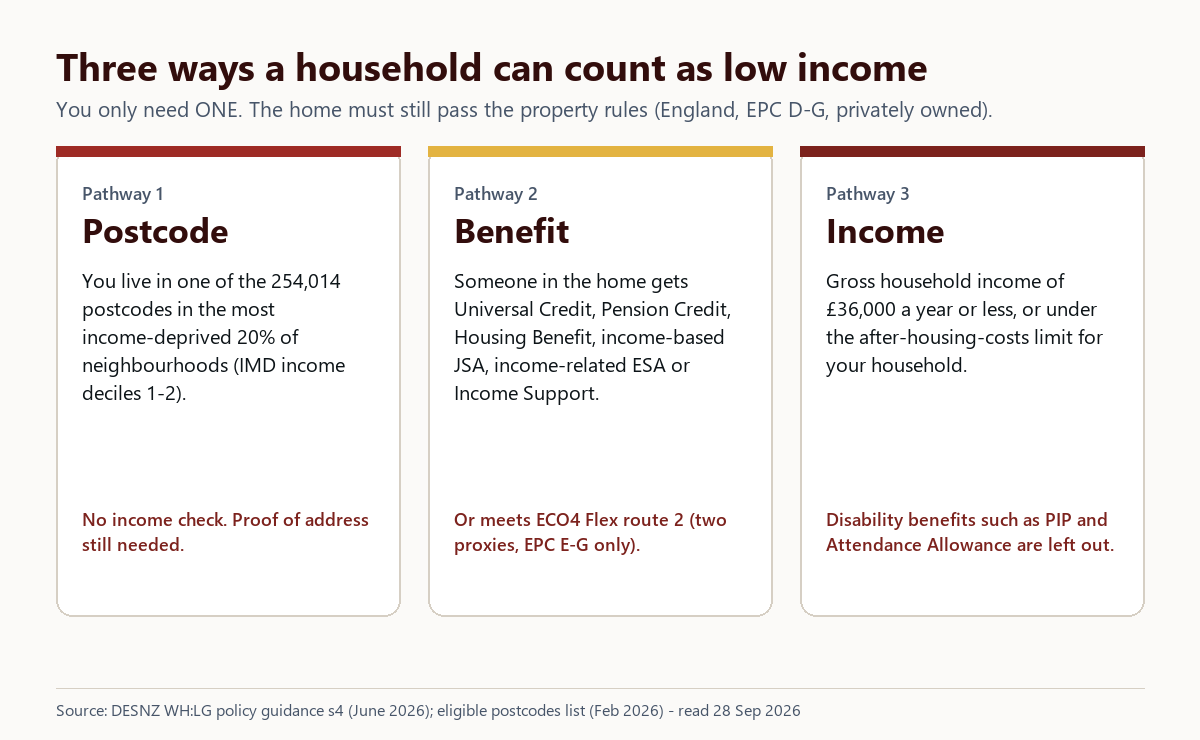
There are three pathways. You only need to meet one.
Pathway 1: you live in an eligible postcode
The government publishes a list of postcodes that sit in the most income-deprived fifth of neighbourhoods in England, measured by the income deciles 1 and 2 of the Index of Multiple Deprivation. The current list, updated in February 2026 from the 2025 index, holds 254,014 postcodes in 6,751 neighbourhoods across 100 postcode areas.
If your postcode is on it, you are treated as income eligible without an income check. You still need proof of address, and the home still has to pass the property rules. Our postcode checker searches the full list.
One quirk: homes verified in the first delivery year (2025/26) using the older 2019-based list can still be upgraded. New applications from the second year onwards must use the 2025 list.
Pathway 2: someone gets a listed benefit (or meets ECO4 Flex route 2)
If anyone in the household, other than a lodger or an adult in full-time education, receives one of these, the household is income eligible with no further check:
- Universal Credit
- Pension Credit (guarantee or savings element)
- Housing Benefit
- Income-based Jobseeker’s Allowance
- Income-related Employment and Support Allowance
- Income Support
The list may be updated during the scheme. There is a second way into this pathway: households can qualify through route 2 of ECO4 Flex, the council-run proxy targeting used under the Energy Company Obligation. It needs at least two compatible proxies (such as eligibility for council tax reduction, being vulnerable to cold, or a referral from Citizens Advice or an energy supplier), and it only applies to homes rated EPC E, F or G, not D.
Pathway 3: household income is £36,000 or less
If neither of the first two fits, the household needs a gross annual income of £36,000 or less: that is before tax, counting every adult except students in full-time education and lodgers. Disability benefits that pay for extra needs are left out.
If you earn more than £36,000, you can still qualify under the after-housing-costs test. Take net income, subtract rent or mortgage payments (not council tax, energy or ground rent), and compare what is left with the limit for your household, which runs from £20,000 for a single adult to £40,000 for two adults with five dependants. The income limits page has the full tables and a calculator.
Half two: does the home pass the property rules?
| Rule | What it means in practice |
|---|---|
| In England | Scotland, Wales and Northern Ireland have their own schemes |
| Rated EPC D, E, F or G | An energy efficiency score of 68 or below; A to C is excluded in every case |
| An existing home | New builds and self-builds never lived in are excluded |
| Privately owned | Owner-occupied, or let by a private landlord (including a charity landlord that is not a registered social housing provider) |
| Any heating fuel | Mains gas, oil, LPG, coal, electric and heat networks all qualify |
| Park homes | Must be a permanent home with an equivalent D to G rating |
Owner occupiers
Owner occupiers get a fully funded package and cannot be asked to contribute. You may choose to pay for something extra (a measure the retrofit coordinator did not recommend, or a cosmetic finish) but that must be your choice. Councils can decline households with large savings or assets, because the scheme is aimed at people in or at risk of fuel poverty.
Private tenants and landlords
Tenants apply with their landlord’s agreement and never pay. The landlord signs a declaration, the council checks the title deeds, and the landlord’s first home under the scheme can be fully funded. From the second home onwards, the landlord pays 50%. Rentals rated F or G must already have a registered exemption under the private rented sector regulations, because public money cannot be used to bring a home up to the legal minimum. See landlords and tenants.
Social housing
Council and housing association homes are excluded except as infill, when a council treats a connected block or row. Infill social homes are capped at 10% of a project, with the landlord paying at least half.
Homes treated before
A home that had work under the Home Upgrade Grant or Local Authority Delivery scheme can be treated again, but only if the new work gets it to EPC C or includes low carbon heating. Homes treated under ECO have no such condition. The same measure can never be funded twice. More on the predecessor schemes.
Terraces and blocks: the infill rule
Some upgrades, external wall insulation in particular, only make sense across a whole connected row or block. If one household in the middle is over the income limit, the guidance lets the council include it when the average gross income across the connected homes is below £36,000, or at least 75% of the households average no more than £36,000. The homes must physically join, not just share a street. How infill works.
Half three: can your council deliver?
Funding went to 74 council projects involving 271 local authorities, over 97% of those eligible in England. Greater Manchester and the West Midlands receive their money through devolved settlements instead. Being on the list means a council has an allocation; it does not tell you whether it has a waiting list today. Use the council lookup, then apply.
What evidence to have ready
- Photo ID and proof of address for the applicant
- Proof of ownership (or, for tenants, the landlord’s details)
- For pathway 2, a recent benefit award letter
- For pathway 3, payslips, a pension statement, self-assessment figures or bank statements for every adult whose income counts, plus rent or mortgage statements if you are using the after-housing-costs test
- The home’s EPC, if you have it
Common reasons people are told no
My EPC says C but the house is freezing
Then the home is outside the scheme as things stand: A to C ratings are ineligible in all circumstances, with no discretion. If your certificate is old and the home has changed (a boiler removed, an extension, a different heating system), a fresh assessment could produce a different band, because EPCs are now produced with RdSAP 10. Ask the council whether it will reassess before assuming the answer is final.
We earn more than £36,000, so we cannot qualify
Not necessarily. Two routes ignore gross income entirely: living in an eligible postcode, and someone in the home receiving a listed benefit. And the third route has a second test: if rent or mortgage leaves your after-housing-costs income under the limit for your household, you can still qualify. A couple with two children, for example, has an after-housing-costs limit of £28,000. Run the numbers.
I rent from the council
Social housing is not eligible for the grant in its own right. It can only be included as infill when the council treats a connected block or terrace, capped at 10% of a project's homes with the social landlord paying at least 50%. Social landlords upgrade their stock through the separate Warm Homes: Social Housing Fund.
The house is brand new, or we just finished building it
New builds and self-builds that have never been lived in are excluded. The scheme retrofits existing homes only.
Questions people ask
Can I get the Warm Homes: Local Grant if I work?
Yes. Working households qualify through the income pathway if gross household income is £36,000 or less, or under the after-housing-costs limit. Self-employed income counts the same way. You may also qualify through your postcode or through Universal Credit, which many working households receive.
Does Pension Credit count?
Yes. Pension Credit, both the guarantee and savings elements, is on the list of means-tested benefits that make a household income eligible without a further income check.
Is PIP or Attendance Allowance counted as income?
No. Attendance Allowance, Disability Living Allowance, Personal Independence Payment, Armed Forces Independence Payment, Exceptionally Severe Disablement Allowance, Constant Attendance Allowance and Industrial Injuries Disablement Benefit are left out of the gross income calculation. They are not on the qualifying benefits list either, so they do not qualify you on their own.
Whose income counts?
Every adult in the household except anyone in full-time education and lodgers. If you receive rent from a lodger, that rent counts as household income.
Can I self-certify my income?
No. The guidance says self-declarations are not acceptable. The council needs evidence such as payslips, benefit letters or bank statements, and DESNZ has been building a tool that checks income and benefits against DWP and HMRC data.
What if I live in Scotland, Wales or Northern Ireland?
The Warm Homes: Local Grant is England only. Scotland has Warmer Homes Scotland through Home Energy Scotland, Wales has Nest, and Northern Ireland has the Affordable Warmth Scheme and the Northern Ireland Sustainable Energy Programme.
Do I need an EPC before I apply?
You need the home to be rated D to G, but you do not need to commission one first. GOV.UK says you can find your rating when you apply, and existing certificates are on the public EPC register.
Sources
- DESNZ, Warm Homes: Local Grant Policy Guidance for Local Authorities (updated June 2026; GOV.UK update 2 July 2026) (read 28 September 2026)
- GOV.UK, Apply for the Warm Homes: Local Grant to improve a home (read 28 September 2026)
- DESNZ, Warm Homes: Local Grant eligible postcodes (2025 IMD income deciles 1-2), updated February 2026 (read 28 September 2026)
- DESNZ, Warm Homes: Local Grant Updated Delivery Guidance for Grant Recipients (GOV.UK update 2 July 2026) (read 28 September 2026)
- Welsh Government, Get help with energy efficiency in your home (Nest) (read 28 September 2026)
- Home Energy Scotland (read 28 September 2026)
- nidirect, Energy saving grants in your area (read 28 September 2026)
Want a second opinion, or help with what the grant will not cover?
Apply for the grant itself through the official GOV.UK service or your council: it is free and you do not need a go-between. Use this form if you would also like independent retrofit or installation firms that cover your postcode to contact you, for a second opinion, a quote for work outside the grant, or options if you do not qualify. We pass your enquiry on. We cannot approve, speed up or guarantee a grant.
What happens next
- We read your enquiry and check which kind of firm can help.
- We pass it to relevant independent firms that cover your postcode.
- They contact you with questions or a quote. You compare, and decide — with no obligation to go ahead.