Warm Homes Local Grant scams, myths and the real catch
The short answer: it is real, and it is free to apply
The Warm Homes: Local Grant is a genuine scheme. DESNZ publishes its policy and delivery guidance, the list of participating councils, the eligible postcodes and quarterly statistics on GOV.UK. Councils run it, procure the installers and pay for the agreed work. Owner occupiers and private tenants pay nothing, and there is no fee to apply.
Because it is real and generous, its name gets borrowed. The protections below come from how the scheme actually works: anything that contradicts them is a warning sign.
The honest money picture: for a qualifying household this is not a deal to haggle over or a finance product to compare. It is public money your council spends on your home, after checking you qualify. So nobody needs to "sell" it to you, and there is nothing to sign up for with a stranger at the door.
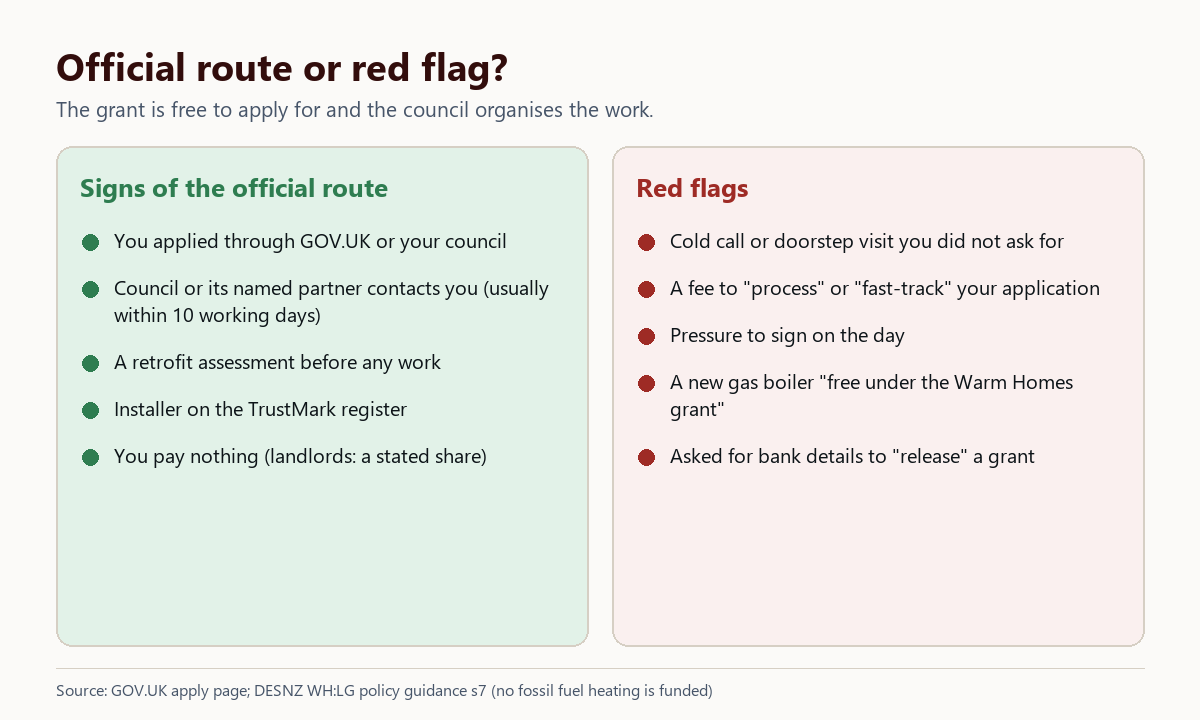
Red flags
| Red flag | Why it does not fit the scheme |
|---|---|
| A fee to apply, “process” or “fast-track” your application | Applying through GOV.UK or your council is free, and nobody can speed up a council decision |
| An unsolicited call or doorstep visit promising a grant | The official route starts with your application, a council eligibility check and a whole-house assessment |
| Pressure to sign on the day | You can stop at any stage, and you decide on any heating system after bill advice |
| A “free new gas boiler” | Fossil fuel heating is not funded |
| Bank details to “release” a grant | The council pays installers directly for agreed work |
| No retrofit assessment before work | Every funded home goes through a PAS 2035 assessment |
| A firm that will not give you its TrustMark or MCS details | Every installer must be TrustMark-registered, and MCS-certified for heat pumps, solar and batteries |
Signs you are on the official route
- You applied through the GOV.UK service or your council’s own route
- The council, or a delivery partner the council names, contacted you, usually within 10 working days
- You were asked for evidence (ID, address, benefit or income proof), because self-declaration is not allowed
- A retrofit assessor surveyed the whole home before any measures were agreed
- The installer’s details check out on the TrustMark register (and MCS where relevant)
- You pay nothing, or, as a landlord from your second home, a clearly stated 50% share
What to do if you are unsure
- Stop. Do not sign, pay or share bank details.
- Check independently. Find your council’s contact details yourself, not from the caller, and ask whether the contact is genuine. The council lookup shows which project covers you.
- Check the firm. Look it up on the TrustMark register and, for heat pumps, solar or batteries, the MCS installer directory. How to check.
- Report it to Action Fraud and your council if something is wrong, and call your bank at once if you have paid.
The real catch
There is one, and it is not hidden: eligibility and capacity. The home must be rated D to G, the household must be on a low income, and the council must have money and contractors when you apply. Councils can decline households with substantial savings or assets, and some run waiting lists. And if you are a landlord, you pay half from your second home. None of that is a trick; it is simply how a targeted scheme works.
A note on this site
This website is an independent guide, not a council or government service, and it cannot approve, speed up or guarantee a grant. It is published by SEO-DONS LTD. If you send us an enquiry, we pass it to independent firms covering your postcode, for a second opinion or a quote for work the grant will not cover. About this site.
Quick check: do the rules fit your home?
Four questions, about a minute. No details needed and nothing is sent anywhere.
This explains the published rules. Only your council (or its delivery partner) can confirm eligibility, after checking evidence.
The myths, one by one
Myth: the grant is a loan you repay later
It is a grant. Owner occupiers cannot be required to contribute, tenants are not expected to pay, and the published rules contain no repayment for households. Landlords do pay a 50% share from their second home, which is stated up front.
Myth: everyone on benefits gets £33,200
The two £16,600 caps are averages across a council's whole project, not an entitlement. What your home gets depends on the retrofit assessment. Many packages are much smaller, and the heating pot only applies when a low carbon heating measure is fitted.
Myth: you can get a free new boiler
Not under this scheme. Fossil fuel heating is excluded, so no new gas, oil or LPG boiler is funded. Anyone selling a "free boiler under the Warm Homes grant" is describing something the scheme does not do.
Myth: you have to use the installer who contacted you
Under the Warm Homes: Local Grant, the council procures the installers. A firm that finds you first cannot guarantee you a grant, and applying through GOV.UK or your council does not require anyone's help.
Myth: it has ended
It has not. The delivery window runs to 31 March 2028. What has ended is the Great British Insulation Scheme (31 March 2026), and ECO4 closes on 31 December 2026, which is where some of the confusion comes from.
Myth: if the council says no, a company can get you in
Eligibility is set nationally and verified by the council with evidence. Self-declaration is not accepted and nobody can buy an exception. A firm claiming it can override a council decision is not telling the truth.
Questions people ask
Is the Warm Homes: Local Grant genuine?
Yes. It is a £500 million government scheme run by councils in England from April 2025 to March 2028, with guidance, eligible postcodes and a list of participating councils published on GOV.UK.
How do I know a caller is really from my council?
Do not rely on the caller. Hang up, find your council's number or website yourself, and ask whether they, or a named partner, contacted you. If you applied through GOV.UK, the contact should come from your council or its delivery partner, usually within 10 working days.
Will a legitimate installer ask for money?
Owner occupiers and tenants pay nothing for grant-funded work, and nobody should ask for a deposit or fee for it. If you choose to add something outside the package, that is a separate, voluntary arrangement. Landlords pay their stated 50% share from their second home.
Are there reviews of the Warm Homes: Local Grant?
The scheme is a government programme rather than a company, so there are no official ratings. DESNZ publishes delivery statistics quarterly; the August 2026 release covered about 11,250 measures in about 5,470 households. Check any installer on the TrustMark register and read its complaints process.
What should I do if I think I have been scammed?
Contact your bank straight away if you paid anything, report it to Action Fraud, and tell your council so it can warn others. Keep any paperwork, messages and numbers.
Is this website a scam?
No, but it is not official either. It is an independent guide published by SEO-DONS LTD (company 16766013). It cannot approve a grant and never charges a fee. Apply through GOV.UK or your council.
Sources
- GOV.UK, Apply for the Warm Homes: Local Grant to improve a home (read 28 September 2026)
- DESNZ, Warm Homes: Local Grant Policy Guidance for Local Authorities (updated June 2026; GOV.UK update 2 July 2026) (read 28 September 2026)
- GOV.UK, Warm Homes: Local Grant - successful local authorities (updated 2 July 2026) (read 28 September 2026)
- DESNZ, Warm Homes: Local Grant statistics - August 2026 (published 27 August 2026) (read 28 September 2026)
- TrustMark, find a registered business (read 28 September 2026)
Want a second opinion, or help with what the grant will not cover?
Apply for the grant itself through the official GOV.UK service or your council: it is free and you do not need a go-between. Use this form if you would also like independent retrofit or installation firms that cover your postcode to contact you, for a second opinion, a quote for work outside the grant, or options if you do not qualify. We pass your enquiry on. We cannot approve, speed up or guarantee a grant.
What happens next
- We read your enquiry and check which kind of firm can help.
- We pass it to relevant independent firms that cover your postcode.
- They contact you with questions or a quote. You compare, and decide — with no obligation to go ahead.