Warm Homes Local Grant eligible postcodes: check yours
Check a postcode against the eligible list
Enter a full postcode. We check it against all 254,014 postcodes on the DESNZ list (pathway 1). Nothing is stored or sent to a third party.
Source: DESNZ "Warm Homes: Local Grant eligible postcodes" (February 2026, built from the August 2025 National Statistics Postcode Lookup and the 2025 Index of Multiple Deprivation). A postcode that is not listed can still qualify through the benefits or income pathways.
How the postcode route works
The Warm Homes: Local Grant has three ways to show a household is on a low income. The postcode route is the simplest: if the home sits in a postcode on the government’s list, the council does not need to check your income at all. The guidance calls this the IMD:ID 1-2 pathway, because it uses the income deciles 1 and 2 of the Index of Multiple Deprivation, the official measure of relative deprivation for small neighbourhoods in England.
The idea was first tried in phase 2 of the Home Upgrade Grant, which went one decile further (deciles 1 to 3). The Warm Homes: Local Grant limits it to deciles 1 and 2 because it also covers homes on the gas grid, a much larger group.
What is on the list
| Figure | Value |
|---|---|
| Eligible postcodes | 254,014 |
| Neighbourhoods (LSOAs) they sit in | 6,751 |
| Postcode areas with at least one eligible postcode | 100 |
| Index used | 2025 Index of Multiple Deprivation (published 30 October 2025) |
| Postcode source | August 2025 National Statistics Postcode Lookup |
| List updated | February 2026 |
Postcodes do not line up exactly with neighbourhoods, so DESNZ assigns each postcode to the neighbourhood it best fits. The list covers England only and says nothing about the other rules: a listed postcode still needs an eligible home.
Where the eligible postcodes cluster
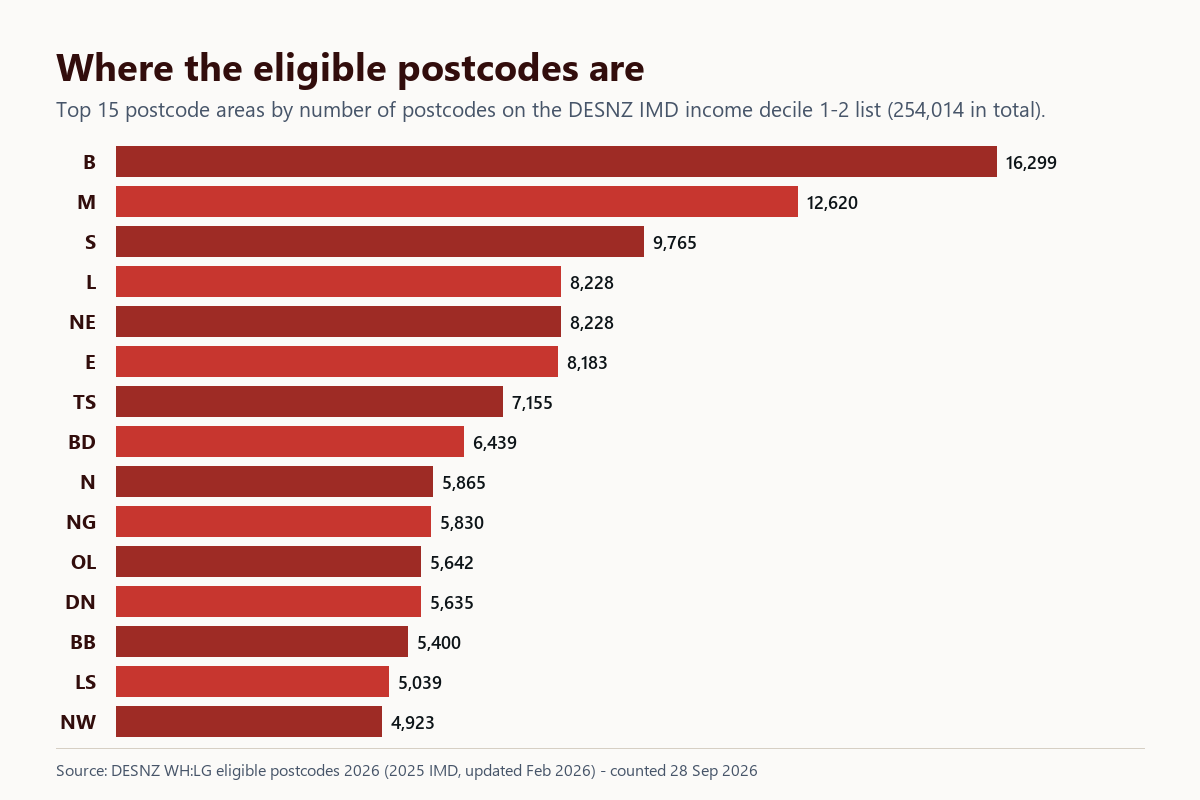
Counting the DESNZ list by postcode area, the largest concentrations are in the big cities of the Midlands and the North, with East London close behind:
| Postcode area | Eligible postcodes |
|---|---|
| B (Birmingham) | 16,299 |
| M (Manchester) | 12,620 |
| S (Sheffield) | 9,765 |
| L (Liverpool) | 8,228 |
| NE (Newcastle) | 8,228 |
| E (East London) | 8,183 |
| TS (Cleveland) | 7,155 |
| BD (Bradford) | 6,439 |
By council, the largest counts are Birmingham (11,586 postcodes in 376 neighbourhoods), Manchester (7,784), Bradford (6,321), Leeds (5,069) and Liverpool (4,952). Two of those, Birmingham and Manchester, are in devolved areas that run their own version of the grant: see Greater Manchester and the West Midlands. The council table shows the eligible postcode count for every project.
If your postcode is listed
- Check the home’s EPC rating is D, E, F or G. Look it up on the GOV.UK EPC register, or find out during the application.
- Find your council with the council lookup so you know which project you are in.
- Apply through the official route. Have ID and proof of address ready; you will not need income evidence.
- Expect contact from the council, usually within 10 working days, and then a retrofit assessment.
If your postcode is not listed
Move on to the other two pathways. The benefits route needs one person in the household on a listed means-tested benefit. The income route needs a gross household income of £36,000 or less, or an after-housing-costs income under your household’s limit, which the income calculator works out.
If the home is part of a connected terrace or block that the council is treating together, the infill rule can bring an otherwise ineligible home into the project.
What a postcode result does and does not mean
My postcode is on the list, so I am approved
Not yet. The postcode settles the income question only. The home still has to be in England, privately owned or rented, and rated EPC D to G, and the council still has to verify your address and have capacity. It is the fastest route in, not an approval.
My postcode is not on the list, so I cannot apply
Wrong: that rules out one pathway of three. If someone in the home gets Universal Credit, Pension Credit, Housing Benefit, income-based JSA, income-related ESA or Income Support, or household income is £36,000 or less (or under the after-housing-costs limit), you can still qualify. See all three.
My neighbour's postcode is on the list but mine is not
That happens at neighbourhood edges. Postcodes are matched to neighbourhoods on a best-fit basis, so two houses on one road can fall either side of a boundary. If you are in a connected terrace or block being upgraded together, the infill rule may still let the council include you.
Questions people ask
Where does the eligible postcode list come from?
DESNZ publishes it as a spreadsheet on GOV.UK. It takes every active postcode in England from the August 2025 National Statistics Postcode Lookup, matches each to a neighbourhood (a Lower Layer Super Output Area), and keeps the postcodes whose neighbourhood falls in income deciles 1 or 2 of the 2025 Index of Multiple Deprivation.
What changed in 2026?
The Index of Multiple Deprivation was updated on 30 October 2025, so a new list was published in February 2026. New applications from the second delivery year must use the 2025 list; homes verified in year one under the 2019-based list can still be upgraded.
Does living in an eligible postcode mean no evidence at all?
No income evidence, but the council will still want proof of address and ID, proof of ownership (or your landlord's details), and the home's EPC rating.
Is my postcode data sent anywhere when I use the checker?
No. The checker downloads a small file for your postcode area from this website and searches it in your browser. Nothing you type is stored or sent to a third party.
Why are there so many eligible postcodes in Birmingham and Manchester when those councils are not on the national list?
Deprivation and scheme delivery are separate questions. Birmingham and Manchester have many income-deprived neighbourhoods, but their councils receive warm homes funding through the West Midlands and Greater Manchester devolved settlements, so they run their own versions of the scheme.
Sources
Want a second opinion, or help with what the grant will not cover?
Apply for the grant itself through the official GOV.UK service or your council: it is free and you do not need a go-between. Use this form if you would also like independent retrofit or installation firms that cover your postcode to contact you, for a second opinion, a quote for work outside the grant, or options if you do not qualify. We pass your enquiry on. We cannot approve, speed up or guarantee a grant.
What happens next
- We read your enquiry and check which kind of firm can help.
- We pass it to relevant independent firms that cover your postcode.
- They contact you with questions or a quote. You compare, and decide — with no obligation to go ahead.