Terraces, flats and the Warm Homes Local Grant infill rule
Updated 28 September 2026 · SEO Dons Editorial
A lot of the homes the Warm Homes: Local Grant was built for are joined to their neighbours: Victorian terraces, inter-war semis, low-rise blocks of flats and maisonettes. Some upgrades, external wall insulation above all, only make sense across a whole building or row. The scheme’s rules recognise that.
Flats and terraced houses qualify like any other home
There is nothing special about a flat or a terrace for eligibility. The household needs to be on a low income through one of the three pathways (an eligible postcode, a listed benefit, or income of £36,000 or less or under the after-housing-costs limit), and the home must be in England, privately owned or privately rented, already lived in, and rated EPC D to G.
A privately owned flat in a block that is otherwise social housing can still qualify in its own right; the social homes around it are the ones with restrictions.
Why councils like to work street by street
DESNZ encourages area-based upgrades “to help achieve economies of scale and value for money”. The postcode route supports it: every household in an eligible postcode is treated as low income without an income check, and the guidance invites councils to use those areas “to achieve economies of scale by upgrading multiple households in concentrated areas of fuel poverty”. The Warm Homes Plan goes further, saying the government intends to shift towards area-based delivery from 2027/28.
The infill rule
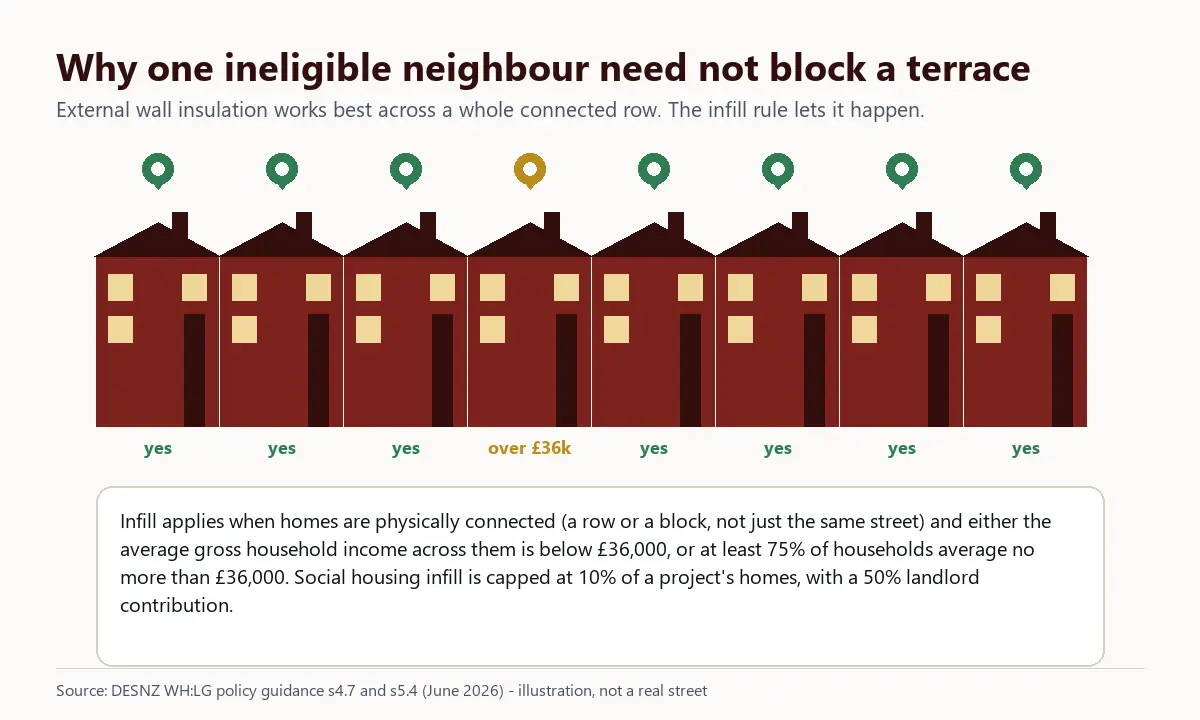
The problem with area-based work is the one household that does not fit. The guidance gives the example of “a couple of homes in a block of flats or row of terraced houses” that are not income eligible and “may prevent the successful upgrading of the collective buildings”. Its answer is infill.
A council can include those homes when either:
- A) the average gross household income across the block of flats, houses or maisonettes is below £36,000 a year, or
- B) at least 75% of households have a combined income average of no more than £36,000 a year
The guidance’s own example: a block of flats may contain one household whose income exceeds £36,000 while the others are below it. Averaging allows the higher-income household to be included and receive subsidised upgrades.
The homes must physically connect
Infill applies to adjacent buildings “where the exclusion from upgrades will be at the detriment of the larger collective”, for example “preventing a block or row of connected properties from receiving external wall insulation because of an ineligible property in the middle”. The homes must be physically connected, “rather than simply in the same street, area or community”. Two detached houses on the same road are not infill.
Homes rated above band D
If a home in the row is rated C or above, it is outside the grant’s property rule. The guidance says the council “may choose to upgrade this home using alternative sources of funding”, so it is not automatically left out of a whole-row project, but the Warm Homes: Local Grant itself does not pay for it.
Social housing in mixed blocks
Social homes are excluded from the grant except as infill. When they are included:
- they must not exceed 10% of the homes a project upgrades
- the social landlord must contribute at least 50% of the total cost
- the council must keep evidence that it is genuine infill
Councils wanting to upgrade blocks that are mainly social housing are pointed towards the Warm Homes: Social Housing Fund, and the guidance suggests combining the two schemes for mixed-tenure projects where a council has funding from both.
Leaseholders and shared buildings
For flats, work on walls, roofs and shared parts usually needs the freeholder’s or managing agent’s agreement. The guidance does not change that. If you own a leasehold flat, raise the grant with your freeholder early; the council’s retrofit coordinator will need to know who can consent to work on the structure.
What a whole-row project might include
External wall insulation is the classic whole-row measure, and one of five with a confidential price limit councils must meet on average. Other measures in a terrace project might include loft insulation, underfloor insulation, solar PV on each roof, and heat pumps, each chosen per home by the retrofit coordinator within the caps (up to £16,600 energy performance and £16,600 low carbon heating per home, averaged across the project). External wall insulation in detail.
If your street is being approached
Area-based projects can involve letters or visits from the council, its named delivery partner, or a local charity: the guidance encourages councils to use community organisations to find eligible households. That is legitimate when it is genuinely on the council’s behalf. Check before you share details: find your council’s contact information yourself and confirm the project. Spotting fake offers.
Sources: DESNZ Warm Homes: Local Grant policy guidance s4.2, s4.7, s5.1 and s5.4 (June 2026); Warm Homes Plan (January 2026). Read 28 September 2026.