Council insulation grants: which councils deliver the Warm Homes Local Grant
Look up your council
Type your district, borough, city or unitary council. Checked against the GOV.UK list of 73 lead authorities and 204 consortium members (updated 2 July 2026).
Being on the list means your council received an allocation. It does not mean it has capacity today: councils can run waiting lists or pause sign-ups. See the full table or check your postcode.
How council delivery works
The Warm Homes: Local Grant is funded by the Department for Energy Security and Net Zero but run entirely by councils. In late 2024 every eligible local authority in England was invited to submit an expression of interest; the window closed on 1 December 2024, and allocations were announced on 11 March 2025. Every eligible council that completed the form received funding, and delivery opened on 1 April 2025.
Most councils did not bid alone. They formed consortia under a lead authority, which holds the allocation, procures a supply chain and draws funding down in batches of homes that are “ready to retrofit”: signed up, verified, assessed and costed. Councils can spend up to 15% of their project on administration and ancillary costs such as finding eligible households, surveys and specialist advice.
The numbers on the GOV.UK list
| Figure | Value |
|---|---|
| Lead authorities named | 73 |
| Consortium member councils named | 204 |
| Total of listed allocations | £483.3 million |
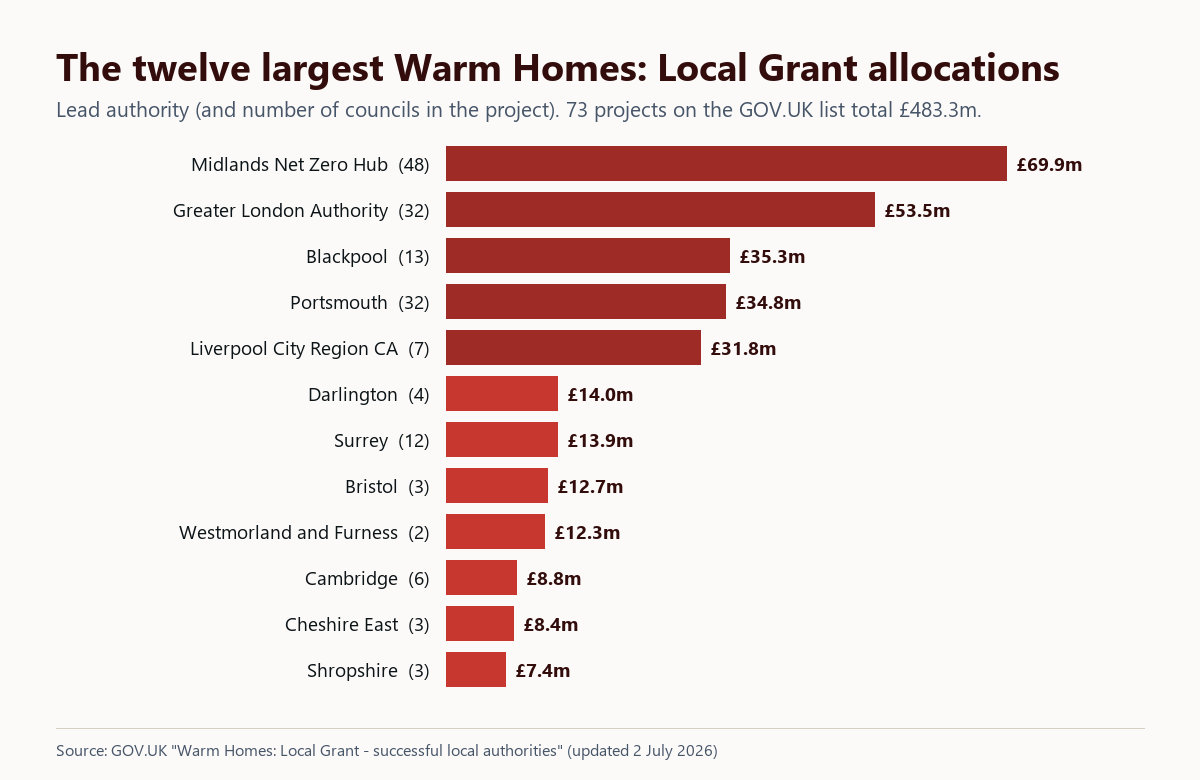
| Largest project | Midlands Net Zero Hub, £69.9m, 47 member councils |
| Second largest | Greater London Authority, £53.5m, 31 boroughs |
| List last updated | 2 July 2026 |
The single largest projects are regional. The Midlands Net Zero Hub runs one project for 47 councils from Derbyshire to Lincolnshire and Warwickshire; the Greater London Authority’s covers 31 London boroughs (Barking and Dagenham runs its own); Blackpool leads a Lancashire consortium of 13 councils with £35.3m; Portsmouth leads 32 councils across Hampshire, Sussex, Berkshire and beyond with £34.8m; and the Liverpool City Region Combined Authority’s £31.8m covers its six boroughs.
Many smaller councils run their own projects, often with allocations around £1.5m, including Ashford, Basildon, Canterbury, Gateshead, St Albans, Slough, Stevenage and Sunderland.
Eligible postcodes by project
The table’s last column adds a second official data set: how many postcodes on the DESNZ eligible postcode list fall inside each project’s councils. It is a rough guide to how many households could qualify without an income check. It is not a measure of demand or of how much each home will get, and households outside those postcodes can still qualify through benefits or income.
County councils, the Greater London Authority, combined authorities and the Midlands Net Zero Hub show no count of their own because deprivation data is published by district and borough; their projects are counted through their members.
Councils outside the national list
Greater Manchester and the West Midlands. The guidance names 17 councils that cannot take part because their combined authorities received warm homes money through integrated settlements: Birmingham, Coventry, Dudley, Sandwell, Solihull, Walsall and Wolverhampton in the West Midlands, and Bolton, Bury, Manchester, Oldham, Rochdale, Salford, Stockport, Tameside, Trafford and Wigan in Greater Manchester. How the devolved route works.
Councils not named. Eleven councils have neighbourhoods on the eligible postcode list but do not appear by name on the GOV.UK list: they are in the second table below. The list is the published position as of 2 July 2026; if you live in one of these areas, ask the council what is available and start on the GOV.UK service.
Allocation is not availability
A council on the list has money for 2025 to 2028. That does not tell you whether it can take your application this month. Councils draw funding down in batches, contractor capacity varies, and each council decides how to manage demand fairly. The only way to find out where you stand is to apply and ask how your council prioritises.
Every project on the GOV.UK list
| Lead authority | Other councils in the project | Allocation 2025-28 | Eligible postcodes in area |
|---|---|---|---|
| Ashford | Runs its own project | £1,500,000 | 230 |
| Barking and Dagenham | Runs its own project | £2,644,879 | 2,053 |
| Barnsley | Runs its own project | £1,538,552 | 1,923 |
| Basildon | Runs its own project | £1,500,000 | 882 |
| Blackpool | Blackburn with Darwen, Burnley, Chorley, Hyndburn, Lancaster, Pendle, Preston, Ribble Valley, Rossendale, South Ribble, West Lancashire, Wyre | £35,324,700 | 10,139 |
| Bradford | Runs its own project | £6,330,820 | 6,321 |
| Bristol | Bath and North East Somerset, North Somerset | £12,662,001 | 2,677 |
| Broadland | Breckland, North Norfolk, King's Lynn and West Norfolk, South Norfolk | £4,713,154 | 691 |
| Broxbourne | Runs its own project | £1,070,786 | 189 |
| Buckinghamshire | Runs its own project | £3,023,682 | 330 |
| Calderdale | Runs its own project | £3,206,150 | 1,704 |
| Cambridge | East Cambridgeshire, South Cambridgeshire, Fenland, Huntingdonshire, Peterborough | £8,805,153 | 1,840 |
| Canterbury | Runs its own project | £1,500,000 | 576 |
| Central Bedfordshire | Runs its own project | £1,000,000 | 102 |
| Cheshire East | Cheshire West and Chester, Warrington | £8,392,725 | 2,868 |
| Cornwall | Isles of Scilly | £3,383,632 | 1,727 |
| County Durham | Runs its own project | £2,055,853 | 3,639 |
| Dacorum | Runs its own project | £2,337,982 | 149 |
| Darlington | Stockton-on-Tees, Middlesbrough, Redcar and Cleveland | £13,953,865 | 6,449 |
| Devon | East Devon, Exeter, Mid Devon, North Devon, Teignbridge, Torbay, Torridge | £4,064,026 | 1,691 |
| Doncaster | Runs its own project | £1,604,111 | 2,821 |
| Dorset | Bournemouth, Christchurch and Poole | £4,441,457 | 1,015 |
| Dover | Runs its own project | £2,186,318 | 694 |
| East Hertfordshire | Runs its own project | £1,500,000 | 0 |
| East Lindsey | Boston, South Holland | £6,069,746 | 1,866 |
| East Riding of Yorkshire | Runs its own project | £1,500,000 | 670 |
| Essex | Braintree, Brentwood, Castle Point, Chelmsford, Colchester, Epping Forest, Harlow, Maldon, Rochford, Tendring, Uttlesford, Southend-on-Sea, Thurrock | £6,000,000 | 3,581 |
| Gateshead | Runs its own project | £1,500,000 | 1,390 |
| Gravesham | Runs its own project | £1,117,648 | 509 |
| Great Yarmouth | Runs its own project | £2,638,910 | 967 |
| Greater London Authority | Barnet, Bexley, Brent, Bromley, Camden, City of London, Ealing, Enfield, Greenwich, Hackney, Hammersmith and Fulham, Haringey, Harrow, Havering, Hillingdon, Hounslow, Islington, Kensington and Chelsea, Kingston upon Thames, Lambeth, Lewisham, Merton, Newham, Redbridge, Richmond upon Thames, Southwark, Sutton, Tower Hamlets, Wandsworth, Waltham Forest, Westminster | £53,470,024 | 38,019 |
| Hartlepool | Runs its own project | £2,391,408 | 1,488 |
| Kingston upon Hull | Runs its own project | £3,402,806 | 3,134 |
| Leeds | Runs its own project | £5,963,439 | 5,069 |
| Leicester | Runs its own project | £4,507,699 | 2,479 |
| Lewes | Eastbourne, Hastings, Rother, Wealden, East Sussex | £4,781,852 | 1,848 |
| Liverpool City Region Combined Authority | Liverpool, Halton, Knowsley, Sefton, St Helens, Wirral | £31,805,813 | 13,565 |
| Medway | Runs its own project | £1,305,900 | 1,123 |
| Midlands Net Zero Hub | Amber Valley, Bassetlaw, Bolsover, Chesterfield, Derby, Derbyshire Dales, Erewash, High Peak, Mansfield, Newark and Sherwood, North East Lincolnshire, North Lincolnshire, Oadby and Wigston, Rushcliffe, South Derbyshire, Stoke-on-Trent, Stratford-on-Avon, Warwick, Malvern Hills, Worcester, Wychavon, Cannock Chase, East Staffordshire, Lichfield, Newcastle-under-Lyme, South Staffordshire, Stafford, Staffordshire Moorlands, Tamworth, Ashfield, Broxtowe, Gedling, Blaby, Harborough, Hinckley and Bosworth, Melton, North West Leicestershire, Charnwood, North Warwickshire, Nuneaton and Bedworth, Bromsgrove, Redditch, Lincoln, North Kesteven, West Lindsey, South Kesteven, Rugby | £69,859,402 | 17,009 |
| Newcastle upon Tyne | Runs its own project | £290,551 | 2,374 |
| North East Derbyshire | Runs its own project | £5,160,618 | 263 |
| North Hertfordshire | Runs its own project | £1,500,000 | 207 |
| North Northamptonshire | Runs its own project | £2,003,912 | 1,039 |
| North Tyneside | Runs its own project | £5,043,385 | 1,067 |
| North Yorkshire | Runs its own project | £5,974,078 | 861 |
| Northumberland | Runs its own project | £2,695,853 | 1,632 |
| Norwich | Runs its own project | £5,504,964 | 881 |
| Oxfordshire | Cherwell, Oxford, South Oxfordshire, Vale of White Horse, West Oxfordshire | £4,394,990 | 402 |
| Plymouth | Runs its own project | £3,024,995 | 1,335 |
| Portsmouth | Adur, Arun, Basingstoke and Deane, Bedford, Bracknell Forest, Brighton and Hove, Chichester, Crawley, Croydon, East Hampshire, Eastleigh, Fareham, Gosport, Hart, Havant, Horsham, Isle of Wight, Luton, Mid Sussex, Milton Keynes, New Forest, Reading, Rushmoor, Rutland, Southampton, Test Valley, West Berkshire, Winchester, Windsor and Maidenhead, Wokingham, Worthing | £34,807,254 | 11,493 |
| Sevenoaks | Runs its own project | £1,670,000 | 110 |
| Sheffield | Runs its own project | £4,006,008 | 3,918 |
| Shropshire | Herefordshire, Telford and Wrekin | £7,418,506 | 1,926 |
| Slough | Runs its own project | £1,500,000 | 853 |
| Somerset | Runs its own project | £7,035,064 | 927 |
| South Tyneside | Runs its own project | £1,500,000 | 1,537 |
| St Albans | Runs its own project | £1,500,000 | 67 |
| Stevenage | Runs its own project | £1,500,000 | 34 |
| Stroud | South Gloucestershire, Cotswold, Cheltenham, Gloucester, Forest of Dean, Tewkesbury | £5,481,399 | 1,650 |
| Suffolk | Babergh, East Suffolk, Ipswich, Mid Suffolk, West Suffolk | £6,183,974 | 2,033 |
| Sunderland | Runs its own project | £1,500,000 | 2,742 |
| Surrey | Epsom and Ewell, Guildford, Elmbridge, Woking, Tandridge, Mole Valley, Spelthorne, Surrey Heath, Waverley, Runnymede, Reigate and Banstead | £13,914,375 | 275 |
| Thanet | Runs its own project | £1,548,220 | 1,250 |
| Tunbridge Wells | Runs its own project | £1,382,964 | 37 |
| Wakefield | Runs its own project | £1,499,667 | 2,097 |
| Watford | Three Rivers | £3,750,031 | 539 |
| Welwyn Hatfield | Runs its own project | £1,500,000 | 105 |
| West Devon | South Hams | £3,315,320 | 30 |
| West Northamptonshire | Runs its own project | £2,606,931 | 1,043 |
| Westmorland and Furness | Cumberland | £12,328,580 | 1,844 |
| Wiltshire | Runs its own project | £3,035,320 | 482 |
| Wyre Forest | Runs its own project | £1,600,000 | 586 |
| York | Runs its own project | £2,037,677 | 215 |
Allocation is for the whole project across the 2025 to 2028 delivery window. "Eligible postcodes in area" counts postcodes on the DESNZ IMD income decile 1-2 list (February 2026) whose neighbourhood falls in the lead or member councils; county councils, the Greater London Authority, combined authorities and the Midlands Net Zero Hub are counted through their member districts and boroughs.
Councils with eligible postcodes that the list does not name
These 11 councils have neighbourhoods on the DESNZ eligible postcode list but do not appear by name on the GOV.UK list, either as a lead or a consortium member. That does not prove there is no help locally: ask the council, or start on the GOV.UK service.
| Council | Eligible postcodes | Neighbourhoods (LSOAs) |
|---|---|---|
| Kirklees | 3,419 | 80 |
| Nottingham | 3,172 | 96 |
| Rotherham | 2,425 | 59 |
| Swindon | 774 | 21 |
| Swale | 652 | 16 |
| Folkestone and Hythe | 560 | 12 |
| Maidstone | 429 | 9 |
| Hertsmere | 234 | 4 |
| Fylde | 84 | 2 |
| Dartford | 75 | 3 |
| Tonbridge and Malling | 75 | 2 |
Council questions people ask
My council is on the list but says it has no funding
An allocation covers the whole 2025 to 2028 window and is drawn down in batches, so a council can be between batches, waiting on contractors, or holding a waiting list. The guidance lets each council choose how to manage demand, first come first served or another fair method, so ask how it prioritises and whether you can register now.
My council is not on the list at all
Check three things. Is it one of the 17 Greater Manchester or West Midlands councils on the devolved route? Is it a district inside a county-led consortium (Devon, Essex, Suffolk, Surrey and Oxfordshire county councils lead projects that include their districts)? If neither, it is one of the few councils not named on the list: ask the council directly and use the GOV.UK service, which routes eligible applications to the right authority.
Do I apply to the lead authority or my own council?
Usually through the route your own council advertises, or through the GOV.UK service. In a consortium, the lead authority holds the money and often runs the sign-up centrally, but referrals can be handled by each member council. The guidance leaves that choice to each project.
Questions people ask
Which councils are doing the Warm Homes: Local Grant?
The GOV.UK list, updated 2 July 2026, names 73 lead authorities and 204 consortium members. DESNZ counts 74 council projects involving 271 local authorities, over 97% of those eligible in England. Use the lookup or the table on this page to find yours.
Can I get free insulation from my council?
If your household qualifies for the Warm Homes: Local Grant and your council's project has capacity, insulation recommended by the retrofit assessment is fully funded for owner occupiers and private tenants. Landlords pay 50% from their second home onwards.
Why are Birmingham and Manchester missing?
Greater Manchester Combined Authority and West Midlands Combined Authority received their Warm Homes: Local Grant money through integrated settlements, so their 17 councils cannot join the national scheme. They run their own routes.
What is a consortium?
A group of councils delivering one project under a lead authority, which receives the allocation and usually procures the installers for everyone. The Midlands Net Zero Hub's project, for example, covers 47 councils.
Does a bigger allocation mean a better chance?
Not directly. Allocations reflect the size of each project's area and plans. What matters for you is whether your council has capacity when you apply and how it prioritises demand.
Sources
- GOV.UK, Warm Homes: Local Grant - successful local authorities (updated 2 July 2026) (read 28 September 2026)
- DESNZ, Warm Homes: Local Grant Policy Guidance for Local Authorities (updated June 2026; GOV.UK update 2 July 2026) (read 28 September 2026)
- DESNZ, Warm Homes: Local Grant eligible postcodes (2025 IMD income deciles 1-2), updated February 2026 (read 28 September 2026)
- DESNZ, Warm Homes: Local Grant Updated Delivery Guidance for Grant Recipients (GOV.UK update 2 July 2026) (read 28 September 2026)
Want a second opinion, or help with what the grant will not cover?
Apply for the grant itself through GOV.UK or your council: it is free and you do not need a go-between. If you would also like independent firms covering your postcode to contact you (for a second opinion, or a quote for work the grant will not cover), tell us about your home. We cannot approve or speed up a council grant.
What happens next
- We read your enquiry and check which kind of firm can help.
- We pass it to relevant independent firms that cover your postcode.
- They contact you with questions or a quote. You compare, and decide — with no obligation to go ahead.