Retrofit assessment: the PAS 2035 home survey, step by step
Why every funded home gets one
The Warm Homes: Local Grant requires every upgrade to comply with the latest PAS 2035 guidance, currently PAS 2035:2023. The guidance’s glossary describes PAS 2035 as a specification for “whole-house” retrofit: an approach that considers the requirements of the entire building, technically and in terms of things like occupant comfort, rather than fitting single measures in isolation.
The point is to avoid the problems single-measure schemes sometimes caused, such as insulation that traps moisture or a heat pump sized without regard to heat loss. Lessons from earlier schemes, and the late discovery of non-compliant work when installations were only checked at the end, are why the Warm Homes: Local Grant puts lodgement and quality checks throughout the process.
The people involved
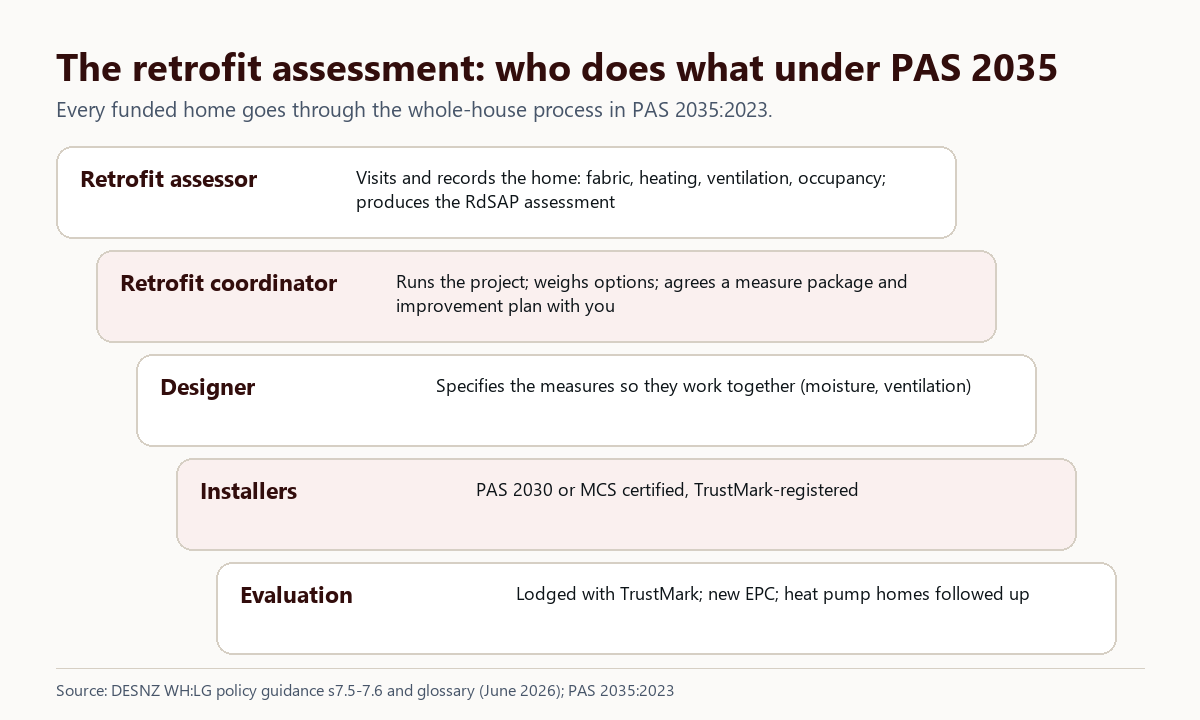
| Role | What they do |
|---|---|
| Retrofit assessor | Visits and records the home: construction, fabric, heating, ventilation, condition and how it is used. Produces the RdSAP assessment |
| Retrofit coordinator | The qualified project manager with overall responsibility: oversees the assessment, identifies and specifies measures, inspects and evaluates, and keeps the project compliant with PAS 2035 |
| Designer | Specifies the measures so they work together |
| Installers | TrustMark-registered and certified to PAS 2030, or MCS for heat pumps, solar and batteries |
| Evaluation | Measures lodged with TrustMark, a new EPC, follow-up for heat pump homes |
What happens on the day
The assessor will want to see every part of the home that matters for energy: walls, windows, doors, the loft if you can reach it, floors, the heating system and hot water, and any signs of damp or ventilation problems. They will also ask how you live in the home: which rooms you heat, when you are in, and whether cost stops you heating it properly. That last question matters. The guidance recognises that many households on low incomes underheat their homes, and expects coordinators to tailor advice so it reflects how you really use energy.
What to have ready
- Access to every room, the loft hatch and the boiler or heating controls
- Recent energy bills, if you have them
- Any certificates for earlier work (insulation guarantees, a previous EPC, boiler service records)
- A list of problems you have noticed: cold rooms, draughts, condensation, mould
From assessment to package
After the survey, the retrofit coordinator designs a package aimed at the largest bill saving for the money, within the caps (up to £16,600 for energy performance and £16,600 for low carbon heating per home, averaged across the council’s project). The guidance’s aspiration is EPC band C “wherever possible within the cost caps”. Where that is not possible, upgrades can still go ahead: fuel-poor households should not be excluded because their home is hard to treat.
The guidance also asks coordinators to prepare an alternative package in case a quote for a particular measure comes in too high, and to consider a medium-term improvement plan for the home.
RdSAP 10 and your EPC
EPCs for existing homes are produced with the Reduced data Standard Assessment Procedure. A new version, RdSAP 10, launched on 15 June 2025 and replaced RdSAP 2012. Every pre-retrofit assessment after that date, and the post-retrofit assessment that follows, uses RdSAP 10. Homes assessed before 15 June 2025 can be completed under the older method, with a new RdSAP 10 EPC lodged on the government register afterwards.
Quality checks after the work
- A TrustMark PAS 2035 project is created for every home within four weeks of the council’s batch being approved.
- A measure guarantee must be in place before work starts.
- Every measure is lodged in the TrustMark data warehouse by the retrofit coordinator, and the project is closed within six weeks of the work finishing.
- The home gets a new EPC.
- Councils can fund aftercare so you know how to use new technology, and follow-up visits for homes with a new heat pump.
Retrofit assessments outside the grant
If you are paying for work yourself, you can still ask for a PAS 2035-style whole-house assessment from a TrustMark-registered retrofit professional. It is not required for every self-funded job, but it is the same logic the grant follows: understand the whole home before choosing measures. How to check an installer.
Quick check: do the rules fit your home?
Four questions, about a minute. No details needed and nothing is sent anywhere.
This explains the published rules. Only your council (or its delivery partner) can confirm eligibility, after checking evidence.
Worries about the survey
Will I have to pay for the assessment?
Not under the Warm Homes: Local Grant. Councils can use their administration and ancillary budget for assessments, including surveys for homes that later drop out. If anyone asks you to pay for a "grant survey", ask the council whether it is part of their project.
What if I do not like the package?
You can accept part of it or none of it. The decision on any heating system rests with you, and you should get clear advice on bill impacts before a heat pump is agreed.
The assessor said my home needs work first
That is the process working. Structural surveys, asbestos surveys and similar preparatory work can be funded from the council's ancillary budget. Ask the coordinator what is needed and who pays for it before anything is booked.
Questions people ask
What is a retrofit assessment?
A whole-house survey under PAS 2035:2023, the standard for retrofitting homes to improve energy performance. It records the building's fabric, heating, ventilation and condition, plus how the household uses the home, so the measures chosen work together.
What does a retrofit coordinator do?
The retrofit coordinator is the qualified specialist project manager for your home. They oversee the assessment, identify and specify the measures, inspect and evaluate the work, and make sure the project complies with PAS 2035.
How long does a retrofit assessment take?
It depends on the home. The guidance does not set a length, so ask your council's contractor when they book. Allow time for the assessor to see every room, the loft if accessible, and the heating system.
Is a retrofit assessment the same as an EPC?
No, though it includes one. The assessment produces an RdSAP energy assessment (since 15 June 2025 using RdSAP 10), but it goes further, looking at condition, moisture, ventilation and occupancy to design the package.
Do I need a retrofit assessment before applying?
No. The council arranges it after you apply and your eligibility is checked. Do not pay for one yourself in advance for the grant.
What happens after the work is finished?
Measures are lodged in the TrustMark data warehouse, the TrustMark project is closed within six weeks of the work finishing, and the home gets a new EPC. Homes with a new heat pump can get follow-up visits.
Sources
- DESNZ, Warm Homes: Local Grant Policy Guidance for Local Authorities (updated June 2026; GOV.UK update 2 July 2026) (read 28 September 2026)
- DESNZ, Warm Homes: Local Grant Updated Delivery Guidance for Grant Recipients (GOV.UK update 2 July 2026) (read 28 September 2026)
- TrustMark, find a registered business (read 28 September 2026)
Want a second opinion, or help with what the grant will not cover?
Apply for the grant itself through the official GOV.UK service or your council: it is free and you do not need a go-between. Use this form if you would also like independent retrofit or installation firms that cover your postcode to contact you, for a second opinion, a quote for work outside the grant, or options if you do not qualify. We pass your enquiry on. We cannot approve, speed up or guarantee a grant.
What happens next
- We read your enquiry and check which kind of firm can help.
- We pass it to relevant independent firms that cover your postcode.
- They contact you with questions or a quote. You compare, and decide — with no obligation to go ahead.