Renting? How to ask your landlord about the Warm Homes grant
Updated 28 September 2026 · SEO Dons Editorial
If you rent privately and your home is cold and expensive to heat, the Warm Homes: Local Grant can pay for insulation, solar panels or a heat pump at no cost to you. The catch is that you do not own the home, so your landlord has to take part. Your landlord may not have heard of the scheme, or may assume it will cost them a lot. This guide gives you the facts to start that conversation, and a short note you can forward.
Check you qualify first
Before raising it, make sure your household and home fit the rules:
- Your household is on a low income: you live in an eligible postcode, someone in the household receives a listed means-tested benefit (such as Universal Credit or Pension Credit), or gross household income is £36,000 or less (or under the after-housing-costs limit, which counts your rent as a housing cost).
- The home is in England, let by a private landlord (not a council or housing association), and rated EPC D to G. You can look up the rating free on the GOV.UK EPC register.
If you rent from a council or housing association, this grant is not the route: ask your landlord about the Warm Homes: Social Housing Fund instead.
What your landlord will want to know
“What does it cost me?” The first home a landlord puts through the scheme can be fully funded. For each home after that, the landlord pays 50% of the cost of the works. That count runs across the whole scheme, based on the owners named in the title deeds.
“What do I have to sign?” A landlord declaration form for the council, confirming:
- the details needed to decide whether the home gets 100% or 50% funding
- that total public subsidy to the landlord stays within the £315,000 Minimal Financial Assistance limit over three years
- that they understand rents should not be increased as a result of the funded upgrades
- that they will take part in DESNZ surveys about how the scheme works in rented homes
“Who decides what gets done?” A retrofit coordinator, after a whole-house survey, proposes a package. Installers are TrustMark-registered and, for heat pumps, solar and batteries, MCS-certified.
“Is there a catch with F and G ratings?” Yes: homes rated EPC F or G must already have a registered exemption under the private rented sector energy efficiency regulations. The grant cannot be used to bring a home up to the legal minimum.
Why it can suit a landlord too
You do not need to sell it hard, but it is fair to point out that the landlord ends up with a better-rated, better-insulated property at no cost for the first home. Separately, domestic private rented homes are due to need EPC C by 1 October 2030, subject to a spending cap of about £10,000 and exemptions, as confirmed in the Warm Homes Plan. The grant is not a compliance scheme, but many of the measures it funds are the same ones that raise a rating.
Your rights as a tenant during the work
- You pay nothing towards grant-funded work.
- The landlord declares they will not raise the rent because of the funded upgrades.
- You can ask questions at the survey, and you should be told how any new heating system is likely to affect your bills. The guidance says the decision on a heat pump rests with the household, so talk to your landlord about how you will make that decision together.
A note you can forward
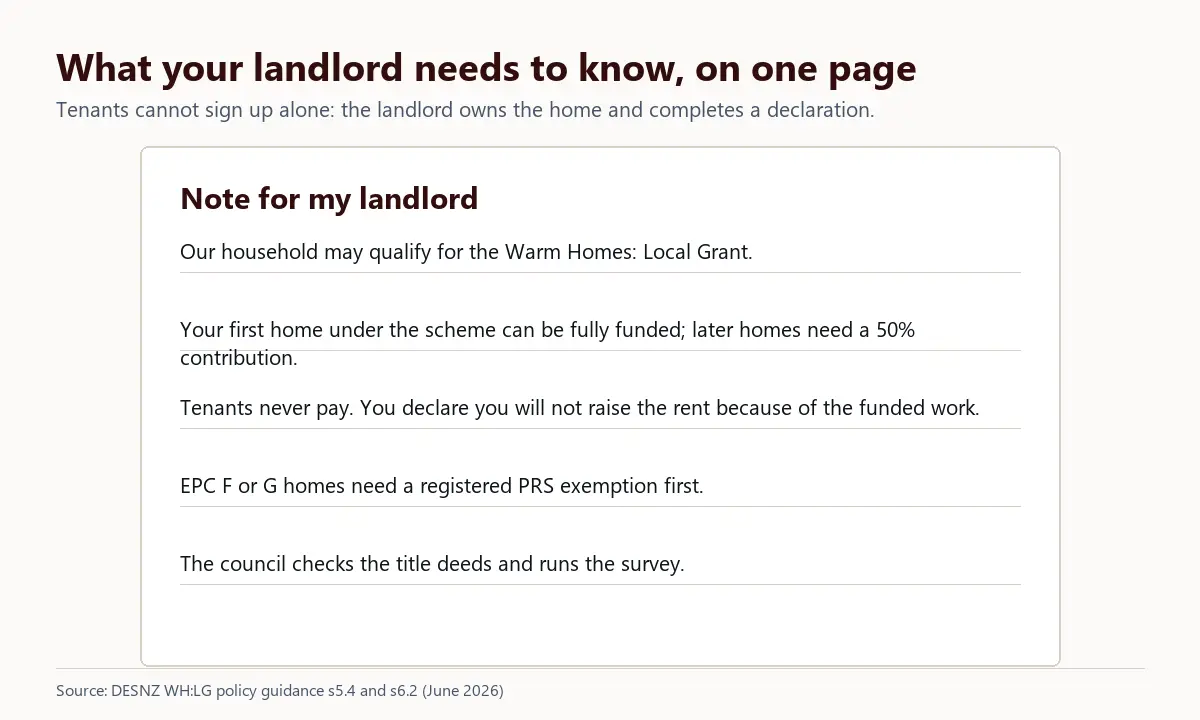
Warm Homes: Local Grant: a note for my landlord
Our household may qualify for the Warm Homes: Local Grant, a government scheme run by councils in England until 31 March 2028. It pays for measures such as insulation, solar panels and heat pumps in privately rented homes rated EPC D to G where the tenant is on a low income.
- A landlord’s first home under the scheme can be fully funded. Later homes need a 50% landlord contribution.
- Tenants do not pay. The landlord declares they will not raise the rent because of the funded work.
- The council checks ownership against the title deeds and arranges a survey. Installers are TrustMark-registered.
- Homes rated EPC F or G need a registered exemption first.
The official information is on GOV.UK: search “Apply for the Warm Homes: Local Grant”. Could we look at it together?
What to do next
- Check the rules with the quick eligibility check.
- Find your council’s project with the council lookup.
- Send your landlord the note above, or a link to the landlords page.
- Either of you can start through the official route; the landlord completes the declaration.
If your landlord says no, the grant cannot go ahead without them. You can still look at help for your bills, such as the Warm Home Discount when it reopens in October 2026.
Sources: DESNZ Warm Homes: Local Grant policy guidance s4, s5.4 and s6.2 (June 2026); Warm Homes Plan (January 2026); GOV.UK Warm Home Discount. Read 28 September 2026.