Warm Homes Local Grant solar panels and batteries
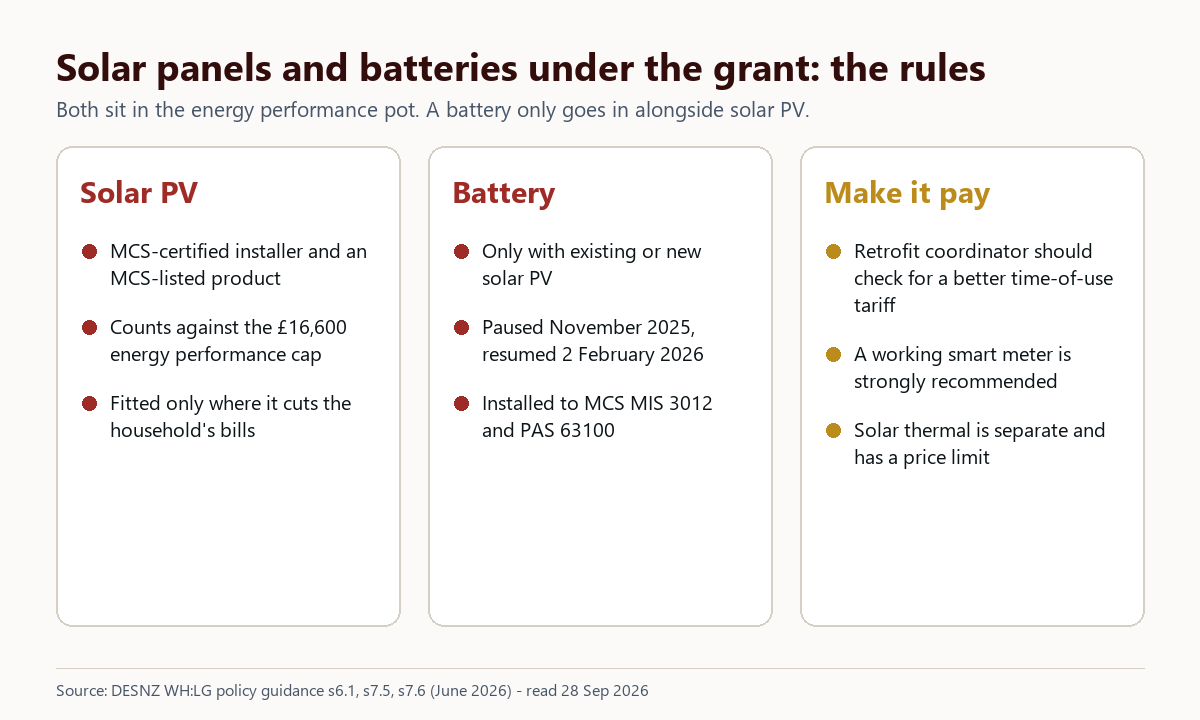
Why solar dominates the grant so far
When DESNZ published the August 2026 statistics, covering the scheme to the end of July 2026, councils had reported about 11,250 measures in about 5,470 households. Solar PV made up 38% of them, more than any other measure. Batteries made up 18% and insulation of all kinds about 24%.
That mix follows from how the scheme is designed. The policy guidance asks councils and retrofit coordinators to choose the package that gives “the largest amount of bill savings for the household” within the caps. It says that will often be fabric measures such as insulation, but “could equally lead to mixed packages (such as insulation and Solar PV) or smart packages such as Solar PV, smart controls, and/or domestic batteries which may achieve higher bill savings for a lower price depending on the home.”
Solar also fits the way the scheme is measured. Progress is tracked through the EPC energy efficiency rating, and generating electricity on site counts towards that rating, while the guidance links heat pump bill savings in on-gas homes to installing them alongside measures such as solar PV.
The rules for solar PV
| Rule | Detail |
|---|---|
| Pot | Energy performance, capped at £16,600 per home on average |
| Product | Must be listed on the MCS product directory |
| Installer | MCS-certified and TrustMark-registered |
| Standard | Installed to the relevant MCS installation standard |
| Lodgement | Lodged in the TrustMark data warehouse, within the PAS 2035 project |
| Recommendation | Only where it drives bill savings for the household |
The council must check the MCS product directory before installation begins. An installation that uses a product not on the directory is not eligible for funding.
The rules for batteries
Batteries were added to the scheme in June 2025, paused in November 2025, and allowed again from 2 February 2026. The pause happened because there was no MCS product standard for batteries; DESNZ then developed an interim solution, supported by the MCS Battery Storage Working Group, which judged batteries on the UK market with UKCA or CE marking sufficiently safe.
Today, for a battery to be funded:
- it must complement existing or new solar PV (a battery on its own is not eligible)
- it must be installed by an MCS-certified installer to MCS 3012, and comply with PAS 63100 and PAS 2035
- it does not need to be on the MCS product directory during the interim period
- it should only be installed where it drives bill savings
DESNZ has said it will not require retrospective compliance with any future standard: batteries installed now under the current guidance will be funded.
Getting the most from solar and a battery
The guidance “strongly recommends” two things when a battery goes in:
- The retrofit coordinator checks whether a time-of-use tariff would suit the household better.
- The battery goes in where there is a working smart meter, or alongside a new one.
Both matter because the value of solar depends on using it. Electricity you generate and use yourself saves your full import price, so shifting use into daylight hours, or storing generation for the evening, is where the saving comes from.
Illustrative example: a smart package
An illustrative example using only the published caps. A semi-detached home rated EPC D is heated by a working gas boiler. The coordinator finds the loft already insulated and the walls hard to treat, and proposes solar PV, a battery and smart heating controls, all energy performance measures. The owner occupier pays nothing; the package counts against the £16,600 energy performance average. If the owner later decides to add a heat pump, that would come from the separate low carbon heating pot, and the retrofit coordinator would first have to explain the likely effect on bills.
Solar and heat pumps together
The guidance notes that on-gas homes are more likely to see bill savings from a heat pump “when installed alongside energy performance improvement measures such as insulation and solar PV”. A combined package uses both pots: energy performance for the solar and insulation, low carbon heating for the heat pump. See heat pumps under the grant.
If you are paying for solar yourself
If you do not qualify, or your council cannot help yet, installing solar panels and batteries in a home is zero-rated for VAT until 31 March 2027, then 5%. Check any installer on the MCS and TrustMark registers before you sign: how to check an installer.
Grant estimator: which pots, and what you would pay
Pick your situation and the measures you are curious about. It shows the ceiling that applies, not what your council will offer: the retrofit coordinator decides the package after the survey.
Caps: £16,600 energy performance + £16,600 low carbon heating per home, averaged across the council's project (raised from £15,000 each in the June 2026 guidance). A pot only counts when a measure from it is installed.
Solar under the grant: the doubts, answered
Will I be forced to have solar panels?
No. The retrofit coordinator recommends a package; you decide what to accept. Solar is recommended where it gives good bill savings for the money, which depends on your roof, shading and how you use electricity.
Can I choose my own panels or installer?
Generally no: the council procures the supply chain and the installer must be MCS-certified and TrustMark-registered, using an MCS-listed product. If you want a specific brand or extra panels, ask whether you can pay for the difference yourself; owner occupiers may self-fund extras the coordinator did not recommend.
I heard batteries were stopped
They were paused, then restarted. Batteries were added as an eligible measure in June 2025, paused in November 2025 because no MCS product standard existed, and allowed again from 2 February 2026 under an interim arrangement backed by the MCS Battery Storage Working Group. Batteries fitted now under that guidance will be funded, and DESNZ has said it will not apply any future standard retrospectively.
Solar only helps if I am home in the day
Partly true, which is exactly why batteries and tariffs matter. A unit you use yourself is worth your full import price; a battery lets you use daytime generation in the evening. The guidance asks the retrofit coordinator to check for a better time-of-use tariff and to make sure a working smart meter is in place.
Questions people ask
Does the Warm Homes: Local Grant pay for solar panels?
Yes. Solar PV is an eligible energy performance measure and the most common one fitted: 38% of measures reported to the end of July 2026. It is paid from the £16,600 energy performance cap, averaged across the council's project.
Can I get a battery on its own?
No. Under the Warm Homes schemes a domestic battery can only be installed where it complements existing or new solar PV.
Who installs council-funded solar panels?
A contractor procured by your council or consortium. For solar PV to be eligible it must be a product listed on the MCS product directory, fitted by an MCS-certified installer to the relevant MCS installation standard, and the installer must be TrustMark-registered.
Will solar panels cut my bill to nothing?
No. Solar reduces the electricity you buy from the grid, most when you use the power as it is generated or store it in a battery. The retrofit coordinator should show you the likely effect on your bills before you agree.
Is solar thermal the same thing?
No. Solar thermal panels heat water rather than make electricity. They are also an eligible energy performance measure, but one of five with a confidential price limit, so they are recommended less often.
If I pay for solar myself, what are the rules?
Outside the grant, installing solar panels and batteries in a home is zero-rated for VAT until 31 March 2027, then 5%. Always check an installer on the MCS and TrustMark registers.
Sources
- DESNZ, Warm Homes: Local Grant Policy Guidance for Local Authorities (updated June 2026; GOV.UK update 2 July 2026) (read 28 September 2026)
- DESNZ, Warm Homes: Local Grant statistics - August 2026 (published 27 August 2026) (read 28 September 2026)
- HMRC VAT Notice 708/6 (via reference/sales/urgency-data.json) (read 28 September 2026)
- MCS, find an installer (read 28 September 2026)
- TrustMark, find a registered business (read 28 September 2026)
Want a second opinion, or help with what the grant will not cover?
Apply for the grant itself through the official GOV.UK service or your council: it is free and you do not need a go-between. Use this form if you would also like independent retrofit or installation firms that cover your postcode to contact you, for a second opinion, a quote for work outside the grant, or options if you do not qualify. We pass your enquiry on. We cannot approve, speed up or guarantee a grant.
What happens next
- We read your enquiry and check which kind of firm can help.
- We pass it to relevant independent firms that cover your postcode.
- They contact you with questions or a quote. You compare, and decide — with no obligation to go ahead.