How much the Warm Homes Local Grant pays, and what it covers
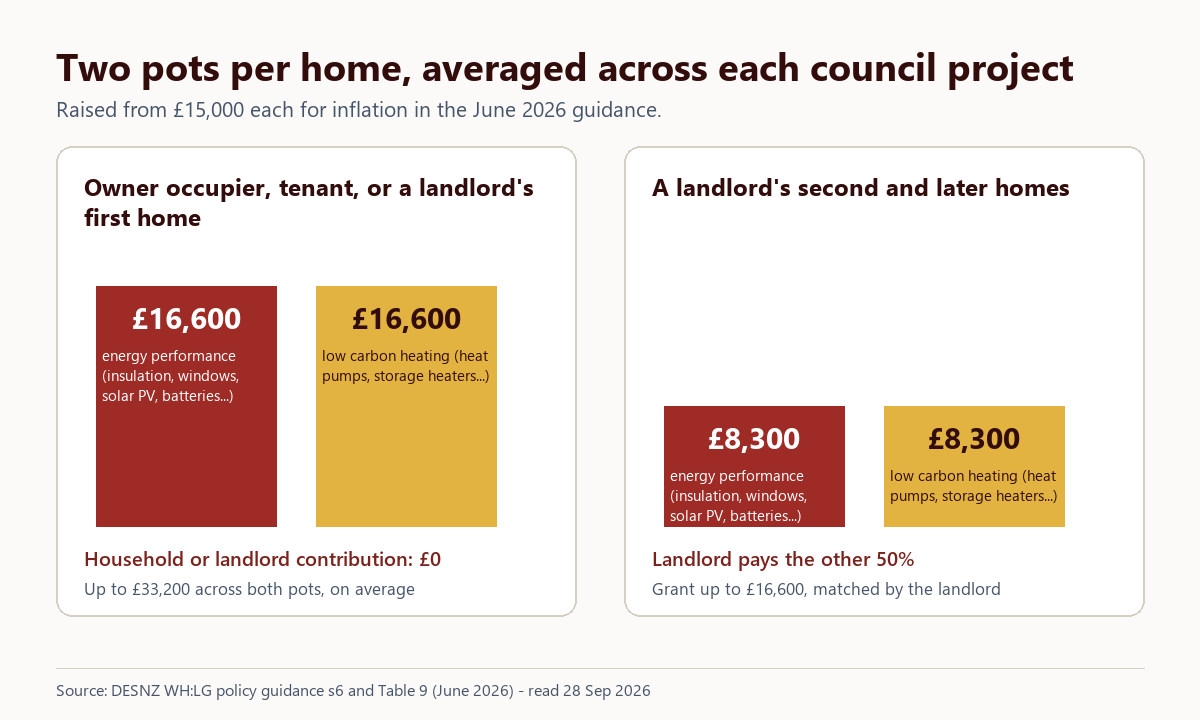
The two pots
The Warm Homes: Local Grant funds two kinds of upgrade from two separate caps, set in the policy guidance updated in June 2026:
| Pot | Cap per home (project average) | What it pays for |
|---|---|---|
| Energy performance | £16,600 | Any energy performance measure that is not heating: insulation, draughtproofing, glazing, doors, heating controls, hot water cylinder measures, low energy lighting, solar PV, solar thermal, batteries |
| Low carbon heating | £16,600 | Heat pumps (air-to-water, ground source, shared ground loops), high heat retention storage heaters, biomass in exceptional rural cases, and the heat pump part of a hybrid in a mains-gas home |
Two details matter. First, both caps are averages across the council’s whole project, to be met by the time the project closes, so a council can spend more on one home and less on another. Second, a pot only “activates” when a measure from it is fitted: a home that gets insulation but no heat pump does not count towards the heating average.
The caps rose from £15,000 each when the guidance was updated “to account for inflation”, and the change applies retrospectively across the scheme. The old mechanism that let councils top up expensive heat pumps from unused insulation money (used under the Home Upgrade Grant) does not exist here.
Who pays what
| Situation | Energy performance grant | Heating grant | Contribution |
|---|---|---|---|
| Owner occupier | up to £16,600 | up to £16,600 | £0, and none may be required |
| Private tenant | up to £16,600 | up to £16,600 | tenant pays nothing |
| Landlord’s first home | up to £16,600 | up to £16,600 | £0 |
| Landlord’s second and later homes | up to £8,300 | up to £8,300 | landlord pays the other 50% |
| Social housing (infill only) | up to £8,300 | up to £8,300 | social landlord pays 50% |
Every eligible measure
Any energy performance or heating measure that the current Reduced data Standard Assessment Procedure (RdSAP) recognises is eligible, except fossil fuel heating. The guidance lists these as examples; it says the list is not exhaustive.
Energy performance measures
- Cavity wall insulation
- Solid wall insulation, external or internal
- Loft insulation and room-in-roof insulation
- Flat roof insulation
- Underfloor insulation
- Park home insulation
- Draughtproofing
- Double or triple glazing, and energy efficient doors
- Heating controls, digital and smart controls
- Hot water cylinder insulation, thermostat, or a new cylinder
- Low energy lighting
- Solar PV and solar thermal
- Domestic batteries, only alongside existing or new solar PV
Low carbon heating measures
- Air source heat pumps (air-to-water)
- Ground source heat pumps and shared ground loops
- High heat retention storage heaters
- Biomass boilers, only in exceptional rural cases
- Retrofit or packaged hybrid systems in homes heated only by mains gas (heat pump part funded)
Not funded
- Any new gas, oil or LPG boiler
- Integrated or compact hybrids (they contain a new gas boiler)
- Hybrids in off-gas homes, or with fossil fuels other than mains gas
- Air-to-air heat pumps and heat batteries, until they can be MCS-certified
- Connections to communal heating or heat networks, until quality standards are in place
How the package is chosen
You do not pick measures from a menu. A retrofit coordinator assesses the whole home and proposes a package that gives the biggest bill saving for the money, aiming for EPC C where that is possible within the caps. The guidance expects that to mean fabric measures (insulation and draughtproofing) in many homes, but also mixed packages such as insulation with solar PV, or “smart” packages of solar PV, controls and a battery, which can save more for less in the right home.
Homes that cannot reach EPC C within the caps are not excluded: the guidance says fuel-poor households should not be left out just because their home is hard to treat.
What councils have actually fitted
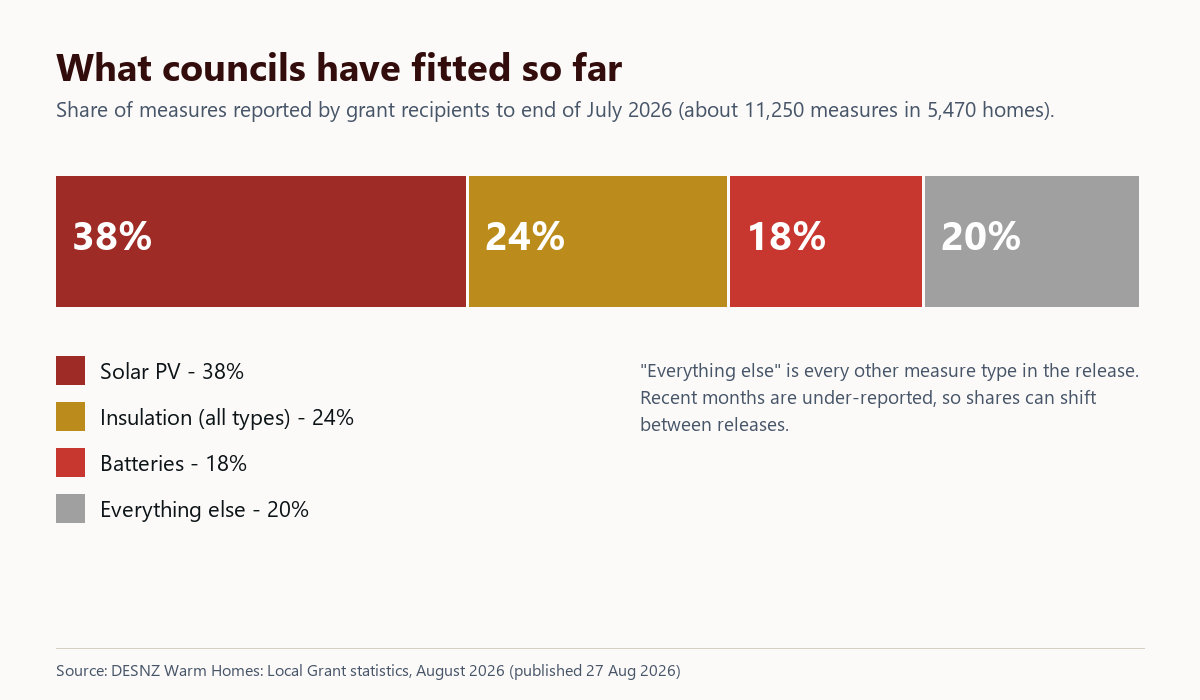
The August 2026 statistics (to the end of July 2026) show about 11,250 measures in about 5,470 households. Solar PV made up 38% of measures, insulation about 24% and batteries 18%. Recent months are under-reported, so the shares will move between releases. More on the delivery statistics.
Price limits on five measures
External wall insulation, internal wall insulation, double and triple glazing, park home insulation and solar thermal each have a price limit councils must meet on average across the project. DESNZ keeps the figures confidential (they are shared under a non-disclosure agreement) because value for money on these measures is especially sensitive to price. It is one reason glazing is recommended less often than insulation.
Grant estimator: which pots, and what you would pay
Pick your situation and the measures you are curious about. It shows the ceiling that applies, not what your council will offer: the retrofit coordinator decides the package after the survey.
Caps: £16,600 energy performance + £16,600 low carbon heating per home, averaged across the council's project (raised from £15,000 each in the June 2026 guidance). A pot only counts when a measure from it is installed.
Money questions, answered straight
Does every home get £33,200?
No. The caps are averages across a council's whole project, not an entitlement per home. One home might get a small loft-and-cavity package and another a much bigger solid-wall and heat pump package; what matters is that the project average stays within the caps by the end. The low carbon heating pot only counts for homes that actually get a low carbon heating measure.
Why do other websites say £15,000 and £30,000?
Because that was the figure until the June 2026 update. The guidance raised both caps to £16,600 "to account for inflation" and applied the change retrospectively across the scheme. Pages written in 2025 or early 2026 have not caught up.
Can I top up the grant to get something extra?
Yes, if you want to. Owner occupiers cannot be required to contribute, but can choose to pay for measures the retrofit coordinator did not recommend or for cosmetic finishes. Landlords can contribute more than their required 50%.
If the grant will not cover it
Some households will not qualify, some councils will have waiting lists, and some upgrades fall outside the package. These are the other ways the cost is met, with their conditions:
- Boiler Upgrade Scheme: £7,500 towards an air-to-water or ground source heat pump in England and Wales, or £9,000 where an off-gas home is replacing oil or LPG (until 31 March 2027); £2,500 for air-to-air. It cannot pay for the same heat pump as the Warm Homes: Local Grant.
- 0% VAT until 31 March 2027: installing insulation, heat pumps, solar panels and batteries in a home is zero-rated until then, and 5% after (VAT Notice 708/6).
- Loans under the Warm Homes Plan: the plan allocates £2,000 million for consumer loans through the Warm Homes Fund. Check GOV.UK for when and how they open; this site does not arrange credit.
- Mix and match, carefully: different schemes can fund different measures in the same home, but never the same measure twice.
Questions people ask
Does the Warm Homes: Local Grant pay for a new boiler?
No. Fossil fuel heating is excluded, so a new gas, oil or LPG boiler is never funded, and integrated or compact hybrids that contain a new gas boiler are excluded too. In a home heated only by mains gas, a separate hybrid system can be installed, but only the heat pump part is funded.
Can I get free windows under the Warm Homes: Local Grant?
Double and triple glazing and energy efficient doors are eligible energy performance measures, but only when the retrofit assessment recommends them, and glazing carries a confidential price limit councils must meet on average. In practice, insulation and solar are chosen far more often.
Is solar PV really the most common measure?
Yes. In the August 2026 statistics, solar PV made up 38% of measures reported by councils, insulation about 24% and batteries 18%.
Does the grant pay for new radiators?
Yes, as part of a low carbon heating installation. Wet central heating pipes and radiators are not a standalone measure, but their cost is recorded under the heat pump measure or as ancillary spend.
Are there limits on what a single measure can cost?
For five measures, yes: external wall insulation, internal wall insulation, double and triple glazing, park home insulation and solar thermal each have a price limit that councils must meet on average. The limits are commercially sensitive and shared only with councils.
Is the grant taxable or counted as income?
The guidance does not treat it as a payment to the household at all: the council pays the installers directly for agreed work. For landlords it counts as a subsidy under the Subsidy Control Act, within a Minimal Financial Assistance limit of £315,000 over three years.
Sources
- DESNZ, Warm Homes: Local Grant Policy Guidance for Local Authorities (updated June 2026; GOV.UK update 2 July 2026) (read 28 September 2026)
- DESNZ, Warm Homes: Local Grant statistics - August 2026 (published 27 August 2026) (read 28 September 2026)
- GOV.UK, Notice of approved grant categories and values for the Boiler Upgrade Scheme (via reference/sales/urgency-data.json, last verified 2026-09-01) (read 28 September 2026)
- HMRC VAT Notice 708/6 (via reference/sales/urgency-data.json) (read 28 September 2026)
- DESNZ, Warm Homes Plan (policy paper, published 21 January 2026, updated 18 March 2026) (read 28 September 2026)
Want a second opinion, or help with what the grant will not cover?
The grant itself is arranged by your council. If you would like independent firms covering your postcode to quote for something the grant will not pay for, or to give a second opinion on a proposed package, tell us about your home. We pass your enquiry on; we are not an installer and cannot approve a grant.
What happens next
- We read your enquiry and check which kind of firm can help.
- We pass it to relevant independent firms that cover your postcode.
- They contact you with questions or a quote. You compare, and decide — with no obligation to go ahead.