External wall insulation grant: solid walls, terraces and the Warm Homes Local Grant
Why solid walls matter to this scheme
The Warm Homes: Local Grant was designed for “low-income households living in the worst quality, privately owned homes in England”. Many of the worst-rated homes have solid walls: no cavity to fill, so heat escapes through the brick or stone. Insulating them means wrapping the outside of the wall (external wall insulation, EWI) or lining the inside (internal wall insulation, IWI).
Both are on the guidance’s list of eligible energy performance measures, paid from the energy performance pot of £16,600 per home, averaged across the council’s project.
The terrace problem, and the infill rule
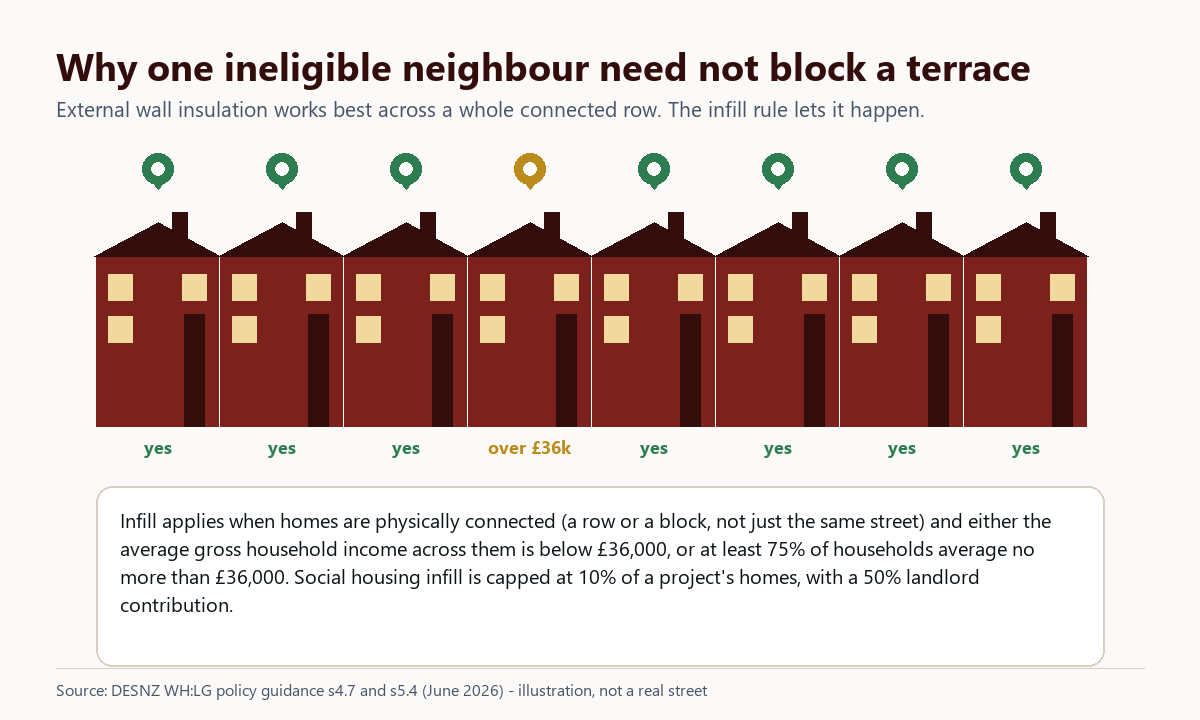
External wall insulation on one house in the middle of a terrace is awkward: the insulation should run continuously across the row, and neighbouring walls, eaves and pipes all connect. The guidance encourages area-based upgrades for economies of scale and value for money, and it deals directly with the household in the row that does not qualify.
Under the infill rule, a council can include connected homes that are not income eligible on their own when:
- the average gross household income across the block of flats, houses or maisonettes is below £36,000 a year, or
- at least 75% of the households have a combined average income of no more than £36,000 a year
The homes must be physically connected, not simply on the same street or in the same area. Social housing can be included as infill too, up to 10% of the homes a project treats, with the social landlord paying at least 50%. Infill in more detail.
The price limit
External wall insulation is one of five measures with a price limit: the others are internal wall insulation, double or triple glazing, park home insulation and solar thermal. DESNZ set these because value for money on these measures is particularly sensitive to installation price. Councils must meet each limit on average across the project by closure, so a council can pay more on one home if others cost less. The figures are commercially sensitive and shared with councils only under a non-disclosure agreement.
In practice this means the retrofit coordinator will weigh EWI against other options. The guidance tells councils to plan an alternative package of fabric and smart measures in case a quote comes in too high, so the household is not left with nothing.
How it fits the whole-house approach
Solid wall insulation changes how a building handles moisture and air, which is why the scheme requires the PAS 2035:2023 whole-house process. A retrofit assessor records the home, a coordinator designs a package that works together, and installers certified to PAS 2030 for the measure do the work, with a guarantee in place before they start. Everything is lodged with TrustMark. What the assessment involves.
Who qualifies
- A low-income household: an eligible postcode, a listed benefit, or a gross income of £36,000 or less (or under the after-housing-costs limit)
- A home in England, privately owned or rented, already lived in, rated EPC D to G
- Owner occupiers and tenants pay nothing; landlords pay 50% from their second home
External wall insulation alongside other schemes
A home can use more than one scheme, but never for the same measure. The guidance gives exactly this example: a household could receive a heat pump under the Warm Homes: Local Grant “alongside funding to install solid wall insulation under ECO”. ECO4 ends on 31 December 2026, and any ECO4 work must be completed wholly before or wholly after the Warm Homes: Local Grant work.
Paying for it yourself
If you do not qualify, installation of insulation in a home is zero-rated for VAT until 31 March 2027, then 5%. External wall insulation can need planning checks depending on the building and location, so ask the installer and your council’s planning team before committing.
Grant estimator: which pots, and what you would pay
Pick your situation and the measures you are curious about. It shows the ceiling that applies, not what your council will offer: the retrofit coordinator decides the package after the survey.
Caps: £16,600 energy performance + £16,600 low carbon heating per home, averaged across the council's project (raised from £15,000 each in the June 2026 guidance). A pot only counts when a measure from it is installed.
Solid wall insulation: the honest trade-offs
Why do some councils seem reluctant to offer external wall insulation?
Two reasons in the rules. External wall insulation is one of five measures with a confidential price limit that councils must meet on average across their project, so costly jobs squeeze the budget. And the whole project must also stay within the £16,600 average per home. The guidance asks councils to prepare an alternative package in case a quote for a particular measure comes in too high.
My neighbour does not qualify. Does that block our terrace?
Not necessarily. Under the infill rule, the council can include connected homes when the average gross household income across them is below £36,000, or at least 75% of the households average no more than £36,000. The homes must physically connect, not just share a street.
External or internal: who decides?
The retrofit assessment and coordinator, with you. Internal wall insulation keeps the outside unchanged but takes room space and means disruption indoors; external changes the look of the building and can need planning checks. Both are eligible and both carry a price limit.
If the grant will not cover it
Some households will not qualify, some councils will have waiting lists, and some upgrades fall outside the package. These are the other ways the cost is met, with their conditions:
- Boiler Upgrade Scheme: £7,500 towards an air-to-water or ground source heat pump in England and Wales, or £9,000 where an off-gas home is replacing oil or LPG (until 31 March 2027); £2,500 for air-to-air. It cannot pay for the same heat pump as the Warm Homes: Local Grant.
- 0% VAT until 31 March 2027: installing insulation, heat pumps, solar panels and batteries in a home is zero-rated until then, and 5% after (VAT Notice 708/6).
- Loans under the Warm Homes Plan: the plan allocates £2,000 million for consumer loans through the Warm Homes Fund. Check GOV.UK for when and how they open; this site does not arrange credit.
- Mix and match, carefully: different schemes can fund different measures in the same home, but never the same measure twice.
Questions people ask
Is there a grant for external wall insulation?
Yes. In England, the Warm Homes: Local Grant funds solid wall insulation, external or internal, for low-income households in privately owned homes rated EPC D to G. It is paid from the £16,600 energy performance pot, averaged across the council's project.
Can I get free external wall insulation?
If your household qualifies and your council's project includes it, owner occupiers and private tenants pay nothing for the agreed work. Landlords pay 50% from their second home. It depends on the retrofit assessment recommending it and the council's budget and price limits.
What is a solid wall insulation grant?
The same thing by another name: solid walls have no cavity to fill, so they are insulated from outside (external wall insulation) or inside (internal wall insulation). The Warm Homes: Local Grant lists solid or external wall insulation and internal wall insulation as eligible measures.
Can social housing in the same terrace be included?
Only as infill: social homes can be included to complete a connected block or row, capped at 10% of a project's homes treated, with the social landlord paying at least 50% of the cost.
Is there a price cap on external wall insulation?
Yes. External wall insulation, internal wall insulation, glazing, park home insulation and solar thermal have price limits councils must meet on average across the project. The figures are commercially sensitive and shared with councils under a non-disclosure agreement.
Does ECO4 still fund solid wall insulation?
ECO4 runs until 31 December 2026. A home can have solid wall insulation under ECO and a heat pump under the Warm Homes: Local Grant, for example, as long as the two schemes do not fund the same measure and the ECO4 work is completed wholly before or after.
Sources
- DESNZ, Warm Homes: Local Grant Policy Guidance for Local Authorities (updated June 2026; GOV.UK update 2 July 2026) (read 28 September 2026)
- Ofgem, Energy Company Obligation (ECO) (read 28 September 2026)
- HMRC VAT Notice 708/6 (via reference/sales/urgency-data.json) (read 28 September 2026)
Want a second opinion, or help with what the grant will not cover?
Apply for the grant itself through the official GOV.UK service or your council: it is free and you do not need a go-between. Use this form if you would also like independent retrofit or installation firms that cover your postcode to contact you, for a second opinion, a quote for work outside the grant, or options if you do not qualify. We pass your enquiry on. We cannot approve, speed up or guarantee a grant.
What happens next
- We read your enquiry and check which kind of firm can help.
- We pass it to relevant independent firms that cover your postcode.
- They contact you with questions or a quote. You compare, and decide — with no obligation to go ahead.