Warm Homes Local Grant income threshold: £36,000, or after housing costs
Two tests, and you only need to pass one of them
The income pathway is the third of the three ways a household can count as low income for the Warm Homes: Local Grant. It exists for households that neither live in an eligible postcode nor receive a listed means-tested benefit.
It has two tests:
- The gross test. Combined gross household income of £36,000 a year or less.
- The after-housing-costs test. For households over £36,000, income after tax and after rent or mortgage payments below the limit for the household’s size and make-up.
The after-housing-costs route exists because the same gross income leaves very different amounts to live on depending on housing costs and family size. A single parent with four children renting privately can be in fuel poverty on an income that would be comfortable for a couple with no children and no mortgage.
The gross test, step by step
Add up the gross annual income, before tax and deductions, of every adult in the household, with two exceptions: adults in full-time education and lodgers. Include rent a lodger pays you. Leave out these disability benefits:
- Attendance Allowance
- Disability Living Allowance
- Personal Independence Payment
- Armed Forces Independence Payment
- Exceptionally Severe Disablement Allowance
- Constant Attendance Allowance
- Industrial Injuries Disablement Benefit
If the total is £36,000 or less, the household meets the income pathway. The home still needs to pass the property rules: England, privately owned or rented, and EPC D to G.
The after-housing-costs limits
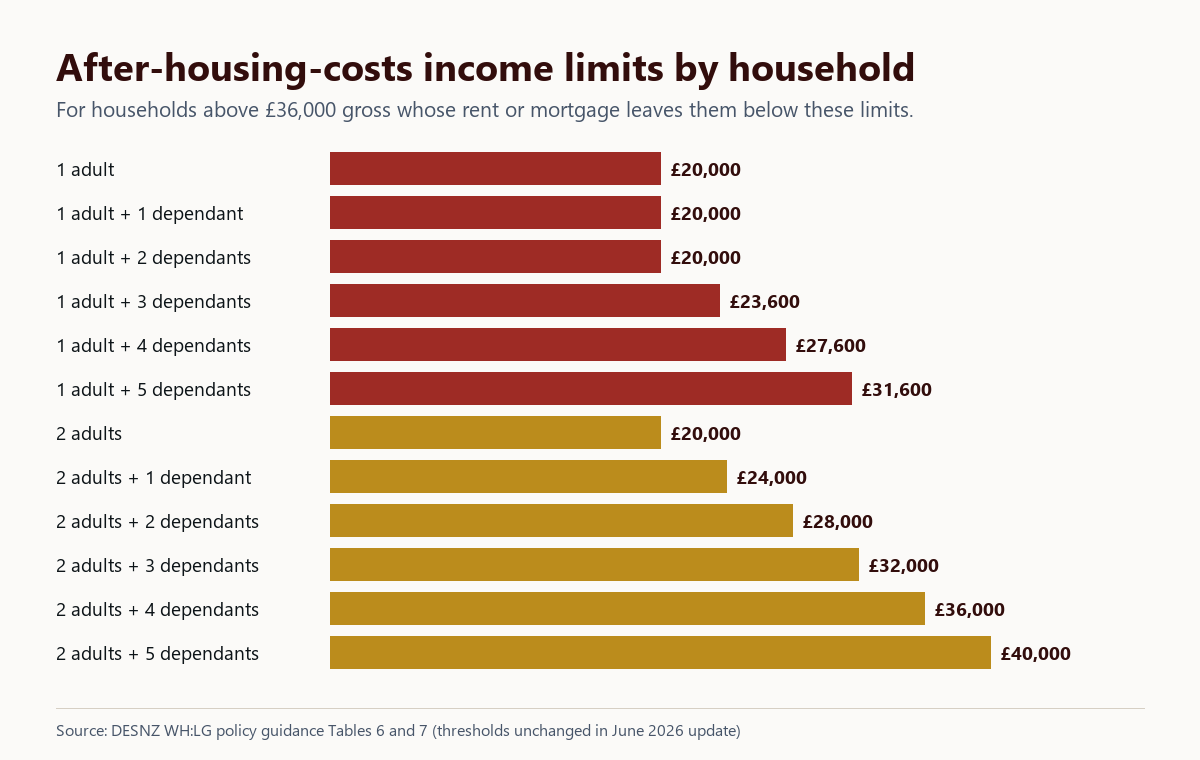
These are the maximum after-housing-costs incomes in the policy guidance. Work out net income (after tax), subtract annual rent or mortgage payments, and compare.
| Household | Maximum after-housing-costs income |
|---|---|
| 1 adult | £20,000 |
| 1 adult + 1 dependant | £20,000 |
| 1 adult + 2 dependants | £20,000 |
| 1 adult + 3 dependants | £23,600 |
| 1 adult + 4 dependants | £27,600 |
| 1 adult + 5 dependants | £31,600 |
| 2 adults | £20,000 |
| 2 adults + 1 dependant | £24,000 |
| 2 adults + 2 dependants | £28,000 |
| 2 adults + 3 dependants | £32,000 |
| 2 adults + 4 dependants | £36,000 |
| 2 adults + 5 dependants | £40,000 |
Housing costs mean rent or mortgage only. Council tax, energy bills and ground rent are not deducted.
Illustrative example: when the second test rescues an application
An illustrative example, using only the published thresholds. A couple with two children has a gross income a little above £36,000, so the gross test fails. Their limit after housing costs is £28,000. If their net income minus their mortgage payments comes to less than £28,000, they meet the income pathway after all. If it comes to more, they would need an eligible postcode or a listed benefit instead. Put your own figures into the calculator on this page to see which side of the line you fall.
What the council will ask for
The guidance is clear that councils must carry out robust checks and that self-declaration is not acceptable. Expect to provide some of the following for each adult whose income counts:
- recent payslips or an employer’s letter
- a pension statement
- self-assessment figures if self-employed
- bank statements
- rent or mortgage statements, if you are using the after-housing-costs test
Councils can use their own data, such as council tax reduction records, to spot households likely to qualify, but neighbourhood-level estimates (the kind of data that predicts incomes by area) cannot be used to verify an individual household’s income unless the tool assesses that household directly.
A digital income check is on the way
DESNZ’s delivery guidance (July 2026) describes an Income Verification Tool that checks, in the background, whether a household is under £36,000, receives a means-tested benefit or lives in an eligible postcode, using DWP and HMRC data. It was expected to arrive alongside a wider government home-upgrade advice service in summer 2026. Applicants do not see the income calculation. Councils keep their manual routes for cases the tool cannot settle.
When income is close to the line
If your income sits just above £36,000, check the other two pathways before giving up:
- Postcode: 254,014 postcodes are on the eligible list, and living in one means no income check at all. Check yours.
- Benefits: a household with anyone receiving Pension Credit, Universal Credit or another listed benefit qualifies without the income test, so if you think you might be entitled to Pension Credit, it is worth checking before you apply.
- After housing costs: the calculator above takes a minute.
And if none of them fits, the grant is not the only route: see other options if you are not eligible.
Income check: gross or after housing costs
Use yearly figures for everyone in the household aged 18 or over, except anyone in full-time education and lodgers (rent a lodger pays you does count). Leave out disability benefits such as PIP, DLA and Attendance Allowance.
Housing costs are rent or mortgage only: not council tax, energy bills or ground rent. The tables cover households of one or two adults with up to five dependants; for other households ask your council how it applies the rule. Councils verify income with evidence (self-declaration is not accepted) and can decline a household with substantial savings or assets.
Where people trip up on the income test
Counting the wrong people
Every adult in the household counts, except adults in full-time education and lodgers. A grown-up son or daughter who works and lives at home counts. A lodger's own income does not, but the rent they pay you does.
Counting disability benefits
Seven non-means-tested disability benefits are excluded from the gross income calculation: Attendance Allowance, Disability Living Allowance, Personal Independence Payment, Armed Forces Independence Payment, Exceptionally Severe Disablement Allowance, Constant Attendance Allowance and Industrial Injuries Disablement Benefit. Leaving them out can bring a household under £36,000.
Using the wrong housing costs
For the after-housing-costs test, housing costs are rent or mortgage payments only. Council tax, energy bills and ground rent do not count.
Assuming savings do not matter
Savings are not part of the income test, but the guidance lets a council decline a household with significant savings or a particularly large asset value even when income is under £36,000, because the grant is meant for homes in or at risk of fuel poverty.
Questions people ask
Is the £36,000 before or after tax?
Before tax. The £36,000 threshold is gross household income, inclusive of tax and other deductions, calculated as an annual figure where possible.
Is the £36,000 limit per person or per household?
Per household. It is the combined gross income of every adult whose income counts, not each person's own income.
Do I need the income test if I get Universal Credit?
No. Universal Credit is one of the listed means-tested benefits, so the household is income eligible without a further income check. The same applies if your postcode is on the eligible list.
What does after housing costs mean?
It is what the household has left after tax and after paying rent or mortgage. Council tax, energy bills and ground rent are not deducted. If that figure is below the limit for your household's make-up, you meet the income pathway even if gross income is above £36,000.
Could the £36,000 threshold change?
Yes. The guidance says the gross threshold will be kept under review and may be updated during delivery. The after-housing-costs table was clarified in June 2026 but the thresholds themselves did not change.
What if my household is three adults?
The published after-housing-costs tables cover one or two adults with up to five dependants. For other households, ask your council how it applies the rule; the gross £36,000 test and the postcode and benefit routes work the same for everyone.
Sources
Want a second opinion, or help with what the grant will not cover?
Apply for the grant itself through the official GOV.UK service or your council: it is free and you do not need a go-between. Use this form if you would also like independent retrofit or installation firms that cover your postcode to contact you, for a second opinion, a quote for work outside the grant, or options if you do not qualify. We pass your enquiry on. We cannot approve, speed up or guarantee a grant.
What happens next
- We read your enquiry and check which kind of firm can help.
- We pass it to relevant independent firms that cover your postcode.
- They contact you with questions or a quote. You compare, and decide — with no obligation to go ahead.