Cavity wall insulation grant: what still funds it in 2026
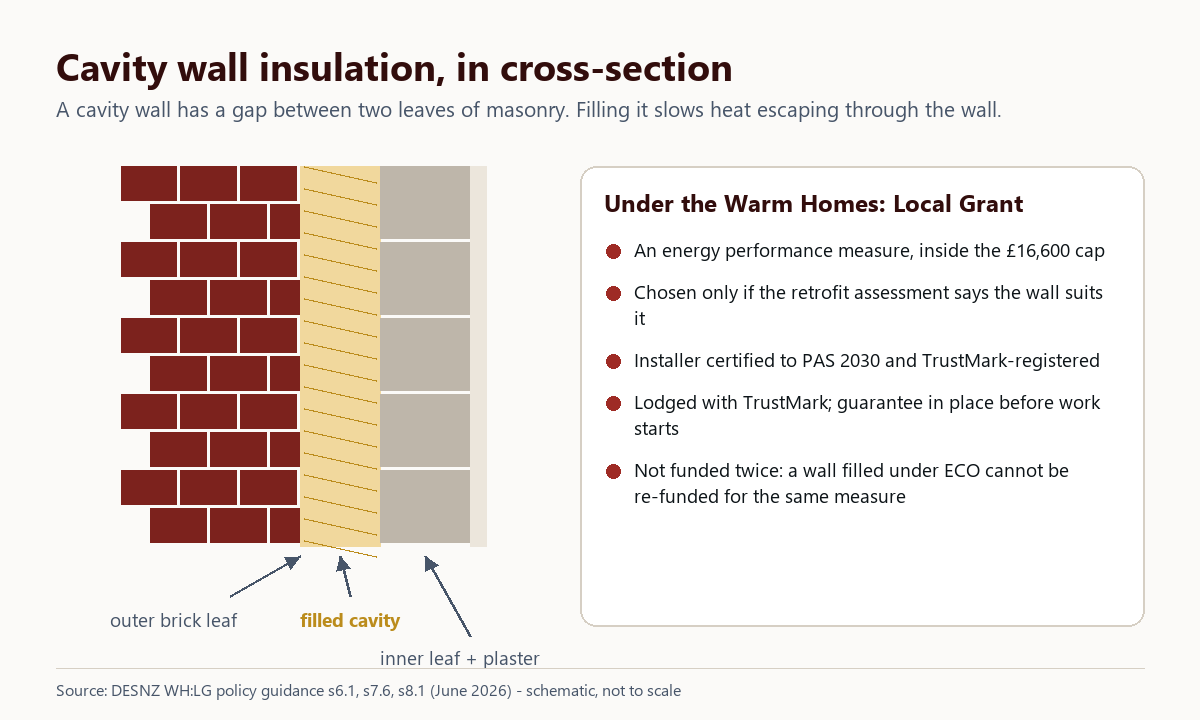
Where cavity wall grants stand in 2026
For years, most people who got cavity wall insulation for free got it through an energy supplier scheme. That is changing. The Warm Homes Plan, published in January 2026, brought supplier obligations to a close: the Great British Insulation Scheme ended on 31 March 2026, and ECO4 runs until 31 December 2026 after a nine-month extension aimed at an orderly closure rather than new delivery targets. The government’s replacement for low-income households is grant funding, delivered first through the Warm Homes: Local Grant.
| Route | Cavity wall insulation? | Who | Status (28 Sep 2026) |
|---|---|---|---|
| Warm Homes: Local Grant | Yes, as an energy performance measure | Low-income households, privately owned homes, EPC D to G, England | Delivering to 31 March 2028 |
| ECO4 | Yes | Low-income and vulnerable households, Great Britain | Ends 31 December 2026 |
| Great British Insulation Scheme | Was a main route | Wider eligibility | Closed 31 March 2026 |
| Paying yourself | Yes | Anyone | 0% VAT until 31 March 2027 |
How cavity wall insulation works under the Warm Homes: Local Grant
Cavity wall insulation is on the guidance’s list of energy performance measures, so it is paid from the energy performance pot, capped at £16,600 per home on average across the council’s project. The same pot also pays for other fabric and smart measures, so cavity wall insulation often sits in a package with loft insulation, draughtproofing or solar PV.
It is not a stand-alone offer. The sequence is:
- You apply and the council verifies your household is eligible.
- A retrofit assessor surveys the whole home to PAS 2035:2023, including the walls, ventilation and signs of damp.
- The retrofit coordinator decides whether the cavity suits filling and what else the home needs, aiming for EPC C where the caps allow.
- An installer certified to PAS 2030 and registered with TrustMark fills the cavity, with a guarantee in place before work starts.
- The measure is lodged with TrustMark and the home gets a new EPC.
Who qualifies
The household must be on a low income: an eligible postcode, a listed means-tested benefit, or a gross household income of £36,000 or less (or under the after-housing-costs limit). The home must be in England, privately owned or privately rented, already lived in, and rated EPC D to G. Owner occupiers and tenants pay nothing. Landlords get their first home fully funded and pay 50% after that.
When cavity walls are not the answer
Not every wall with a cavity should be filled, which is why the assessment comes first. PAS 2035 is a whole-house standard: it looks at the building as a system, including its condition, moisture and ventilation, before any measure is specified. If a cavity is unsuitable, the coordinator should propose something else within the caps.
Homes with solid walls, typical of older terraces, need solid wall insulation instead: external or internal. That is a bigger, more expensive job with its own rules, covered on the external wall insulation grant page.
Previously filled cavities
If the cavity was filled under an earlier scheme, the grant cannot fund the same measure twice. If the old fill has failed, the delivery guidance allows councils to use their administration and ancillary budget for failed insulation or extraction costs, but only where those costs are not covered by an insurance or guarantee from the previous installation. Check whether you have a guarantee certificate from the original work.
Using the grant alongside ECO4 before December
ECO4 and the Warm Homes: Local Grant can both touch the same home, but not the same measure. The guidance says any ECO4 work should happen wholly before or wholly after the Warm Homes: Local Grant work, and each scheme needs its own post-installation EPC and TrustMark lodgement. The EPC after the first scheme is what shows whether the home is still rated D to G and so still eligible for the second. ECO4’s closure explained.
If you do not qualify
You can still pay for cavity wall insulation yourself. Installation of insulation in a home is zero-rated for VAT until 31 March 2027, then 5%. Choose an installer registered with TrustMark and certified for the measure, and ask for the guarantee details in writing before work starts.
Quick check: do the rules fit your home?
Four questions, about a minute. No details needed and nothing is sent anywhere.
This explains the published rules. Only your council (or its delivery partner) can confirm eligibility, after checking evidence.
Cavity wall insulation doubts
Is free cavity wall insulation a scam?
The grant is real, but cold callers use it as a hook. Under the Warm Homes: Local Grant, cavity wall insulation comes after you apply through GOV.UK or your council, after a council check of your eligibility and after a whole-house retrofit assessment. An unsolicited caller offering "free cavity wall insulation" on the doorstep, with no assessment, is not the council process. How to tell the difference.
My cavity was filled years ago. Can it be done again?
The same measure cannot be funded twice. If a wall was filled under ECO, it cannot be refunded as the same measure, but the home can still get other measures. The guidance lets councils use their admin budget to remove failed insulation where it is not covered by an insurance or guarantee from the original installation.
Will the council only do my cavity walls?
Not necessarily. The retrofit coordinator looks at the whole house and proposes the package with the best bill savings for the money, which may combine cavity wall insulation with loft insulation, draughtproofing, solar or a heat pump.
If the grant will not cover it
Some households will not qualify, some councils will have waiting lists, and some upgrades fall outside the package. These are the other ways the cost is met, with their conditions:
- Boiler Upgrade Scheme: £7,500 towards an air-to-water or ground source heat pump in England and Wales, or £9,000 where an off-gas home is replacing oil or LPG (until 31 March 2027); £2,500 for air-to-air. It cannot pay for the same heat pump as the Warm Homes: Local Grant.
- 0% VAT until 31 March 2027: installing insulation, heat pumps, solar panels and batteries in a home is zero-rated until then, and 5% after (VAT Notice 708/6).
- Loans under the Warm Homes Plan: the plan allocates £2,000 million for consumer loans through the Warm Homes Fund. Check GOV.UK for when and how they open; this site does not arrange credit.
- Mix and match, carefully: different schemes can fund different measures in the same home, but never the same measure twice.
Questions people ask
Can I get a cavity wall insulation grant?
In England, the main route in 2026 is the Warm Homes: Local Grant, for low-income households in privately owned homes rated EPC D to G. Owner occupiers and private tenants pay nothing for the agreed package; landlords pay 50% from their second home.
Is the Great British Insulation Scheme still open?
No. The Great British Insulation Scheme ended as planned on 31 March 2026, as the Warm Homes Plan confirmed.
Is ECO4 still paying for cavity wall insulation?
ECO4 runs until 31 December 2026 after a nine-month extension. The Warm Homes Plan describes the extension as time for an orderly closure and the remediation of non-compliant installations, without increased delivery targets.
Who installs cavity wall insulation under the grant?
An installer procured by your council, certified to PAS 2030 for that measure and registered with TrustMark. The work is part of a PAS 2035 project, lodged with TrustMark, with a guarantee in place before it starts.
If I pay for cavity wall insulation myself, is there VAT?
Professional installation of energy-saving materials such as insulation in a home is zero-rated for VAT until 31 March 2027, then 5%.
Does the Warm Homes: Local Grant cover landlords' cavity walls?
Yes, when the tenant's household is eligible. A landlord's first home can be fully funded; from the second home the landlord pays half. EPC F and G rentals need a registered exemption first.
Sources
- DESNZ, Warm Homes: Local Grant Policy Guidance for Local Authorities (updated June 2026; GOV.UK update 2 July 2026) (read 28 September 2026)
- DESNZ, Warm Homes Plan (policy paper, published 21 January 2026, updated 18 March 2026) (read 28 September 2026)
- Ofgem, Energy Company Obligation (ECO) (read 28 September 2026)
- HMRC VAT Notice 708/6 (via reference/sales/urgency-data.json) (read 28 September 2026)
- DESNZ, Warm Homes: Local Grant Updated Delivery Guidance for Grant Recipients (GOV.UK update 2 July 2026) (read 28 September 2026)
Want a second opinion, or help with what the grant will not cover?
Apply for the grant itself through the official GOV.UK service or your council: it is free and you do not need a go-between. Use this form if you would also like independent retrofit or installation firms that cover your postcode to contact you, for a second opinion, a quote for work outside the grant, or options if you do not qualify. We pass your enquiry on. We cannot approve, speed up or guarantee a grant.
What happens next
- We read your enquiry and check which kind of firm can help.
- We pass it to relevant independent firms that cover your postcode.
- They contact you with questions or a quote. You compare, and decide — with no obligation to go ahead.