Park homes and the Warm Homes Local Grant: the three tests
Updated 28 September 2026 · SEO Dons Editorial
Park homes are some of the hardest homes in England to keep warm, and they sit awkwardly in energy rules built around bricks-and-mortar houses. The Warm Homes: Local Grant deals with them explicitly. The DESNZ policy guidance (updated June 2026) says park homes are eligible, with three conditions that do not apply to other homes.
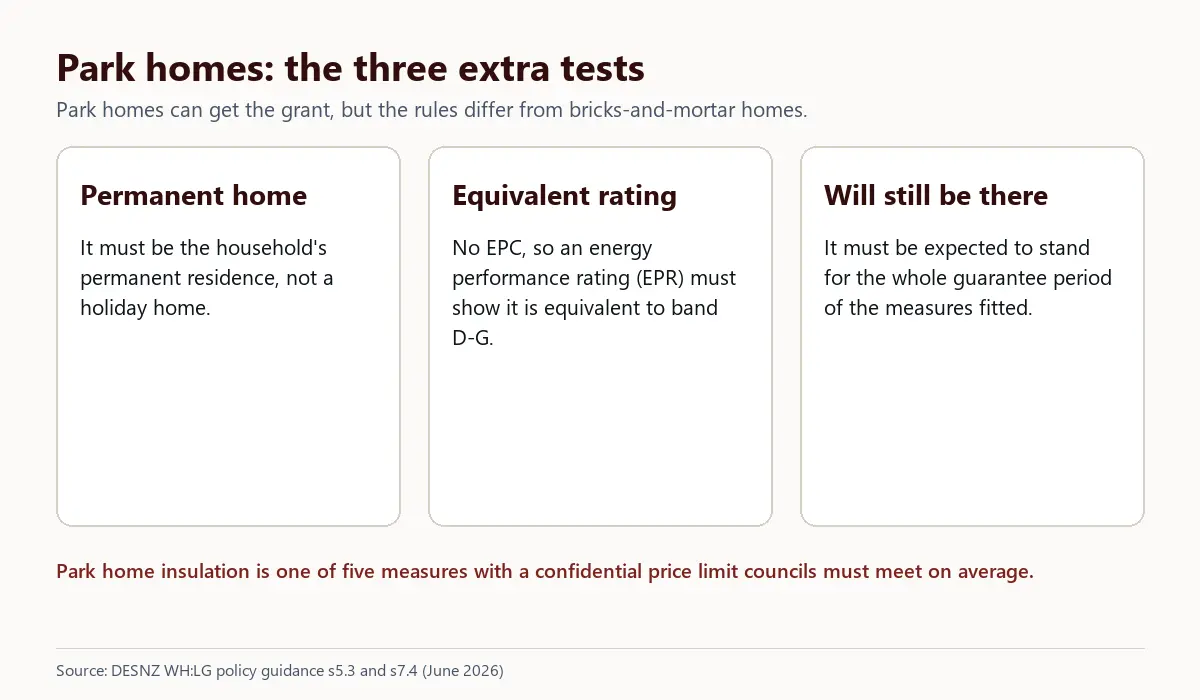
Test one: it must be your permanent home
The guidance requires that “the park home is the permanent residence of the household”. A holiday home or a second home on a leisure park does not qualify. Expect the council to ask for proof of address like any other applicant, and possibly for evidence that the home is lived in all year.
Test two: an equivalent energy rating
Most park homes do not have an Energy Performance Certificate, and the scheme’s normal property test is an EPC of D to G. So park homes “must still be assessed to determine their Energy Performance Rating (EPR), which can evidence equivalence”. In practice, the assessment carried out as part of the retrofit process is used to show the home performs at the equivalent of band D to G.
This is the park home version of the rule that excludes any house rated A to C. A well-insulated modern park home might not pass it; an older one usually will.
Test three: it will still be there
The third test is unique to park homes: the home must be “expected to still exist (i.e. not be demolished) for the whole duration of the measure guarantee period for the measure/s to be installed, or for the longest guarantee period if more than one measure is installed”.
It exists because public money should not pay for insulation or a heat pump on a unit that is about to be removed. If your park’s site licence, your pitch agreement or the condition of the home raises doubts about its future, the council may ask about it.
The household tests are the same as everyone else’s
A park home household qualifies through the same three low-income pathways as any other home:
- an eligible postcode on the DESNZ list, with no income check
- someone in the home receiving Universal Credit, Pension Credit, Housing Benefit, income-based Jobseeker’s Allowance, income-related Employment and Support Allowance or Income Support
- a gross household income of £36,000 or less, or an income after housing costs below the limit for your household
Pitch fees are not listed as a housing cost for the after-housing-costs test, which counts rent or mortgage payments only; if you are unsure how your costs are treated, ask the council.
What a park home might get
Park home insulation is an eligible energy performance measure, funded from the energy performance pot of up to £16,600 per home on average across the council’s project. Solar PV, batteries (with solar), heating controls and draughtproofing are energy performance measures too, and low carbon heating comes from a separate pot of up to £16,600.
One constraint matters: park home insulation is one of five measures with a price limit that councils must meet on average across their project (the others are external and internal wall insulation, glazing and solar thermal). The figures are confidential. It means a council weighing up a costly park home insulation job may look carefully at value for money, and the retrofit coordinator may suggest an alternative package alongside it.
The same protections apply
- A whole-home retrofit assessment to PAS 2035:2023 before anything is agreed
- Installers registered with TrustMark and certified for the measure (MCS for heat pumps, solar and batteries)
- A guarantee in place before work starts, which matters doubly for a park home given the guarantee-period test
- Owner occupiers pay nothing; you decide on any heating change after clear advice on bills
Questions to ask the council about a park home
Because park homes sit outside the normal EPC system, it helps to raise a few points early:
- How will the energy performance rating be assessed, and who carries it out?
- What guarantee period would the proposed measures carry, and does anything about your pitch or site licence need checking against it?
- Which measures suit your home? Park home insulation, solar PV with a battery, heating controls and draughtproofing are all energy performance measures; a heat pump would come from the separate heating pot.
- Will the site owner need to be involved? Work on the outside of a park home, or on a pitch, may need the site owner’s agreement under your pitch arrangements.
If the grant will not cover it: installing energy-saving materials in residential accommodation is zero-rated for VAT until 31 March 2027, then 5% (VAT Notice 708/6); ask your installer to confirm how it applies to your home. Heat pumps outside the grant may qualify for the Boiler Upgrade Scheme (£7,500, or £9,000 replacing oil or LPG off the gas grid until 31 March 2027) if the home meets that scheme's own rules. Never pay a fee to apply for the Warm Homes: Local Grant itself.
Other help for park home residents
- Warm Home Discount: GOV.UK notes that park home residents may need to apply for the £150 discount rather than receive it automatically. The scheme reopens in October 2026.
- Boiler Upgrade Scheme: a separate grant towards a heat pump; check whether your park home qualifies before relying on it.
Next steps
- Check the household pathway with the eligibility quick check.
- Find your council’s project with the council lookup.
- Apply and mention it is a park home, so the council arranges the right assessment.
Sources: DESNZ Warm Homes: Local Grant policy guidance s5.3 and s7.4 (June 2026); GOV.UK Warm Home Discount. Read 28 September 2026.