EPC grant: how your rating decides the Warm Homes Local Grant
The rule in one line
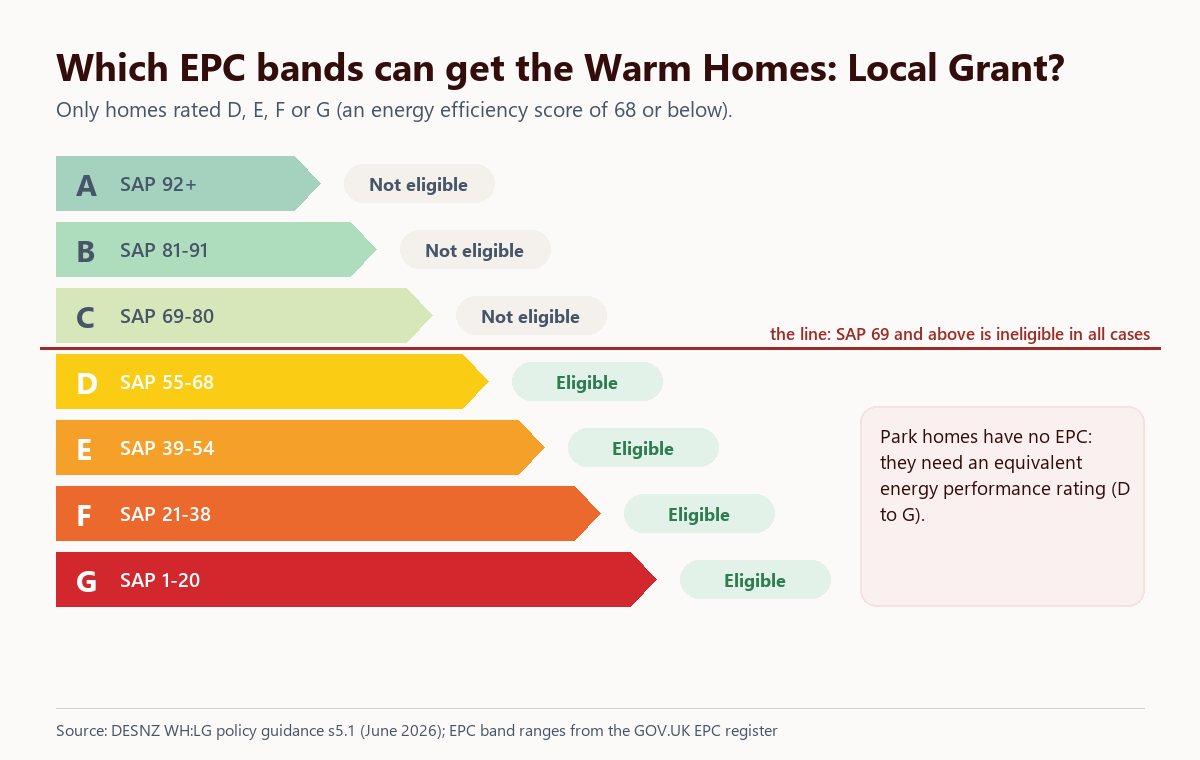
Funding “must only support households living in England in homes with an EPC rating within bands D to G”, which the guidance defines as an energy efficiency rating (SAP score) of 68 or below. Homes rated A to C (a score of 69 or above) are “ineligible for scheme funding in all circumstances”.
That makes the EPC the single most common reason a household is turned down, and the one rule no council discretion can change.
The EPC bands
| Band | SAP score | Warm Homes: Local Grant |
|---|---|---|
| A | 92 and above | Not eligible |
| B | 81 to 91 | Not eligible |
| C | 69 to 80 | Not eligible |
| D | 55 to 68 | Eligible |
| E | 39 to 54 | Eligible |
| F | 21 to 38 | Eligible |
| G | 1 to 20 | Eligible |
How to find your rating
- Search your address on the free GOV.UK Find an energy certificate service.
- Look at the current energy efficiency rating, not the “potential” rating.
- If there is no certificate, or you cannot find it, GOV.UK says you can find your rating when you apply.
Do not pay for a new EPC in advance just for the grant. The retrofit assessment that follows an eligible application includes an energy assessment.
Why band C is the target
The Warm Homes: Local Grant exists first to make progress towards England’s statutory fuel poverty target, which aims to improve as many fuel-poor homes as reasonably practicable to band C by 2030. So every package is designed with band C in mind, as a non-binding aspiration:
- Homes should reach band C “wherever possible within the cost caps”.
- Where that is not possible, upgrades can still go ahead with a value-for-money approach, for example when a heat pump limits how far the score rises.
- Fuel-poor households “should not be excluded from the scheme simply because their home cannot reach EPC band C within the cost caps”.
The one hard condition applies to homes that already had upgrades under the Home Upgrade Grant or Local Authority Delivery scheme: re-treatment must bring them to band C or include low carbon heating. The re-treatment rule.
Measuring the result
The scheme measures progress with the EPC energy efficiency rating, calculated through the Reduced data Standard Assessment Procedure. RdSAP 10 replaced RdSAP 2012 on 15 June 2025. After the work, the home gets a new EPC, lodged on the government register, and measures are lodged with TrustMark.
Special cases
Park homes have no EPC, so they are assessed for an energy performance rating (EPR) to show they are equivalent to D to G. Park home rules.
Privately rented F and G homes need a registered exemption under the Energy Efficiency (Private Rented Property) Regulations 2015 before the grant can fund them. Separately, domestic private rented homes are due to need EPC C by 1 October 2030, subject to a spending cap (about £10,000) and exemptions. Landlords.
Infill homes rated above band D can be upgraded as part of a connected terrace or block, but the guidance says the council may use alternative funding for them, because the grant itself only funds D to G.
When the EPC is borderline
If your home sits at the top of band D, the difference between eligible and ineligible can be a single point. You cannot shop around for a lower score, and nobody legitimate will offer to “fix” a rating. But if the certificate is old or the home has changed since it was issued, it is reasonable to ask the council whether a current assessment is needed.
Quick check: do the rules fit your home?
Four questions, about a minute. No details needed and nothing is sent anywhere.
This explains the published rules. Only your council (or its delivery partner) can confirm eligibility, after checking evidence.
EPC surprises
My certificate is C, but it is ten years old
An old certificate may not reflect the home today, and EPCs for existing homes are now produced with the RdSAP 10 method, which replaced RdSAP 2012 on 15 June 2025. If something significant has changed, such as the heating system, ask the council whether a new assessment is appropriate before ruling yourself out. You cannot choose the result, but you can ask for an accurate one.
My landlord's rental is rated G
F and G rentals can be funded, but only if the landlord has registered an exemption under the private rented sector regulations, because public money cannot bring a home up to the legal minimum. Landlord rules.
The work will not get us to C. Can we still have it?
Usually yes. Band C is an aspiration, not a condition, and the guidance says fuel-poor households should not be excluded because their home cannot reach C within the caps. The exception is a home treated before under HUG or LAD, which must reach C or get low carbon heating this time.
If the grant will not cover it
Some households will not qualify, some councils will have waiting lists, and some upgrades fall outside the package. These are the other ways the cost is met, with their conditions:
- Boiler Upgrade Scheme: £7,500 towards an air-to-water or ground source heat pump in England and Wales, or £9,000 where an off-gas home is replacing oil or LPG (until 31 March 2027); £2,500 for air-to-air. It cannot pay for the same heat pump as the Warm Homes: Local Grant.
- 0% VAT until 31 March 2027: installing insulation, heat pumps, solar panels and batteries in a home is zero-rated until then, and 5% after (VAT Notice 708/6).
- Loans under the Warm Homes Plan: the plan allocates £2,000 million for consumer loans through the Warm Homes Fund. Check GOV.UK for when and how they open; this site does not arrange credit.
- Mix and match, carefully: different schemes can fund different measures in the same home, but never the same measure twice.
Questions people ask
Is there a government grant to improve my EPC rating?
For low-income households in England, the Warm Homes: Local Grant funds insulation, solar, batteries and low carbon heating in privately owned homes rated D to G, with a non-binding aim of reaching band C. There is no general grant simply for improving a rating.
What EPC do I need for the Warm Homes: Local Grant?
D, E, F or G, which means an energy efficiency score (SAP) of 68 or below. A to C (69 and above) is ineligible in all circumstances.
How do I find my EPC rating?
Search your address on the GOV.UK Find an energy certificate service. It is free. GOV.UK also says that if you do not know your rating, you can find it out when you apply for the grant.
Do I need to pay for a new EPC to apply?
No. Do not buy one in advance for the grant. The retrofit assessment includes an RdSAP energy assessment, and the council's project covers it.
What EPC does a park home need?
Park homes do not have EPCs, so they are assessed for an energy performance rating that shows they are equivalent to band D to G.
Will the grant always get my home to band C?
No. Band C is the aim wherever it is possible within the caps. Some homes cannot reach it without costs beyond the caps, and those homes can still be upgraded.
Sources
- DESNZ, Warm Homes: Local Grant Policy Guidance for Local Authorities (updated June 2026; GOV.UK update 2 July 2026) (read 28 September 2026)
- GOV.UK, Find an energy certificate (read 28 September 2026)
- GOV.UK, Apply for the Warm Homes: Local Grant to improve a home (read 28 September 2026)
- Domestic PRS minimum energy efficiency standard (Warm Homes Plan; reference/sales/urgency-data.json) (read 28 September 2026)
Want a second opinion, or help with what the grant will not cover?
Apply for the grant itself through the official GOV.UK service or your council: it is free and you do not need a go-between. Use this form if you would also like independent retrofit or installation firms that cover your postcode to contact you, for a second opinion, a quote for work outside the grant, or options if you do not qualify. We pass your enquiry on. We cannot approve, speed up or guarantee a grant.
What happens next
- We read your enquiry and check which kind of firm can help.
- We pass it to relevant independent firms that cover your postcode.
- They contact you with questions or a quote. You compare, and decide — with no obligation to go ahead.