ECO4 is ending: what it means for the Warm Homes Local Grant
Updated 28 September 2026 · SEO Dons Editorial
For years, much of the free insulation offered to households in Great Britain came through the Energy Company Obligation: a requirement on large energy suppliers to fund upgrades in low-income and vulnerable households’ homes. That era is ending. Understanding how it ends explains a lot about why the Warm Homes: Local Grant now matters so much.
The dates
| Scheme | Status |
|---|---|
| Great British Insulation Scheme (GBIS) | Ended as planned on 31 March 2026 |
| ECO4 | Runs until 31 December 2026, after a nine-month extension |
| Warm Homes: Local Grant | Delivering from 1 April 2025 to 31 March 2028 |
| Single low-income scheme | Intended from 2027/28, merging the Local Grant and the Social Housing Fund |
Ofgem, which administers ECO, says ECO4 “will run until 31 December 2026, following a nine-month extension”. The Warm Homes Plan explains the thinking: alongside its £15 billion investment, the government “took the decision to bring supplier obligations to a close, as these did not represent strong value for money”. The ECO4 extension carries no increased delivery targets and no impact on consumer bills; it is there to allow “additional time for remediation of non-compliant installations, to support an orderly closure of the scheme”.
What replaces ECO
Nothing like-for-like. There is no ECO5 and no new obligation on suppliers. Instead, low-income households are supported through direct government grants, which the Warm Homes Plan describes as around £5 billion to 2030, delivered “initially through the existing Warm Homes Social Housing Fund and Local Grant, before consolidating and integrating our investment into a single scheme for low-income households”.
For a private household in England, that means the Warm Homes: Local Grant is the main route today.
How the two schemes differ
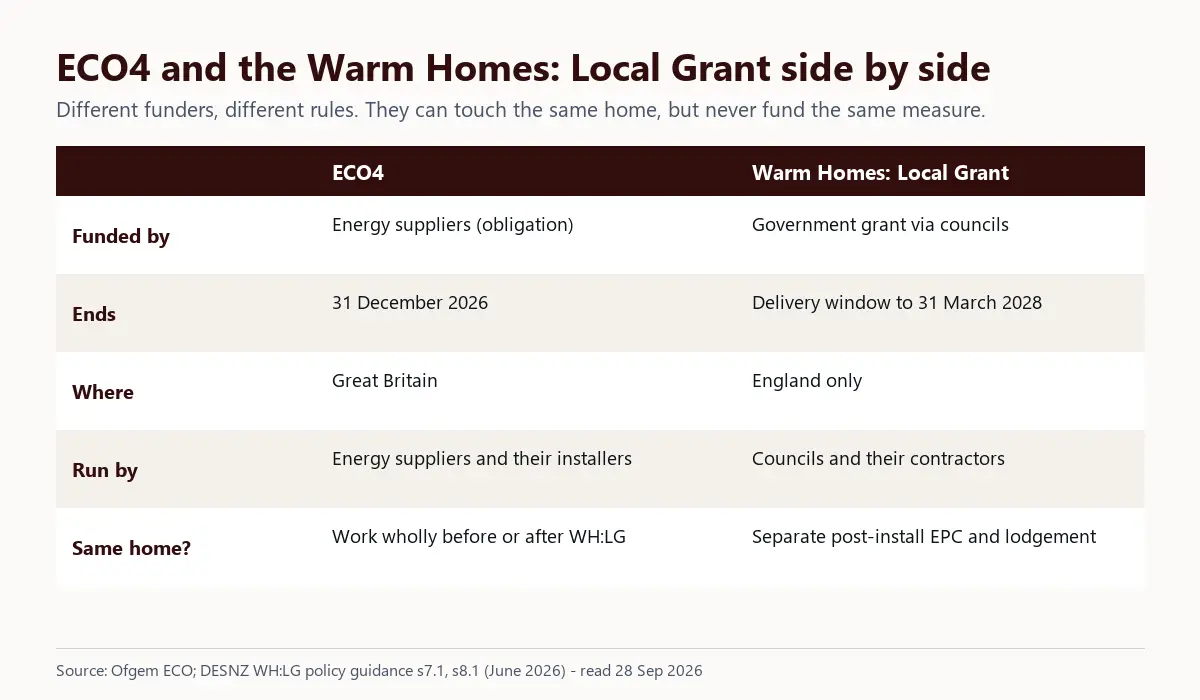
| ECO4 | Warm Homes: Local Grant | |
|---|---|---|
| Funded by | Energy suppliers, under an obligation | Government grant, via councils |
| Run by | Suppliers and their installers | Councils and their procured contractors |
| Where | Great Britain | England only |
| Ends | 31 December 2026 | Delivery window to 31 March 2028 |
| Heating | Varies by case | No fossil fuel heating is funded |
| Money | Varies by measure | Up to £16,600 energy performance + £16,600 low carbon heating per home (project average) |
The Warm Homes: Local Grant also borrows from ECO: a household can qualify through ECO4 Flex route 2, the council-run proxy route used under ECO, where at least two compatible proxies apply and the home is rated EPC E to G. That route is only usable while ECO Flex exists in its current form; DESNZ has said it will issue further guidance if the criteria change significantly.
Can one home use both?
Yes, but carefully. The Warm Homes: Local Grant guidance sets three rules:
- Never the same measure. Funding “must not be blended simultaneously to install the same individual measure” with ECO, the Boiler Upgrade Scheme or social housing schemes. A top-up to a measure installed under a previous scheme is allowed.
- One after the other. “Any ECO4 projects should occur wholly after or wholly before the Warm Homes: Local Grant work in the same property.”
- Separate paperwork. Both schemes need their own post-installation EPC and TrustMark lodgement. The EPC after the first scheme decides whether the home is still rated D to G, and so still eligible for the second.
The guidance gives an example: a household could receive a heat pump under the Warm Homes: Local Grant alongside funding to install solid wall insulation under ECO.
Councils must also stop the same measure being claimed twice, and DESNZ uses data matching between schemes and an Energy Efficiency Installation Checker to check.
Homes that already had ECO work
A home treated under ECO can be treated again under the Warm Homes: Local Grant without the extra condition that applies to homes treated under the old council schemes (HUG and LAD must reach EPC C or get low carbon heating). The only rule is the universal one: the same individual measure cannot be funded twice.
A quick way to tell which scheme a letter is about
Letters and calls about home upgrades can be hard to place. Three clues help:
- Who is it from? ECO4 work is arranged by energy suppliers and their installers; Warm Homes: Local Grant work is arranged by your council or a delivery partner it names.
- Where is the home? The Local Grant is England only. ECO4 covered Great Britain.
- What heating is offered? The Local Grant never funds a new gas, oil or LPG boiler. If a boiler is on offer “under the Warm Homes grant”, something is wrong.
If neither scheme will pay: installing insulation, heat pumps, solar panels and batteries in a home is zero-rated for VAT until 31 March 2027, then 5% (VAT Notice 708/6). The Boiler Upgrade Scheme gives £7,500 towards a heat pump with no income test, or £9,000 where an off-gas home replaces oil or LPG (until 31 March 2027). It cannot fund the same heat pump as the Local Grant.
If you are mid-way through an ECO4 job
If you have an ECO4 installation booked or in progress, ask the installer or supplier how it will be completed before the scheme closes. If you are considering the Warm Homes: Local Grant as well, tell the council about the ECO4 work so the two can be sequenced properly.
If you were hoping for ECO4 and have missed it
Check the Warm Homes: Local Grant first: who qualifies, then your council. Its household tests (postcode, benefits or £36,000 income) are broadly comparable in spirit, it covers homes on and off the gas grid, and it runs to March 2028. If you do not qualify, see other routes.
Sources: Ofgem, Energy Company Obligation; DESNZ Warm Homes Plan (January 2026, updated March 2026); DESNZ Warm Homes: Local Grant policy guidance s4.3, s5.6 and s8.1 (June 2026). Read 28 September 2026.